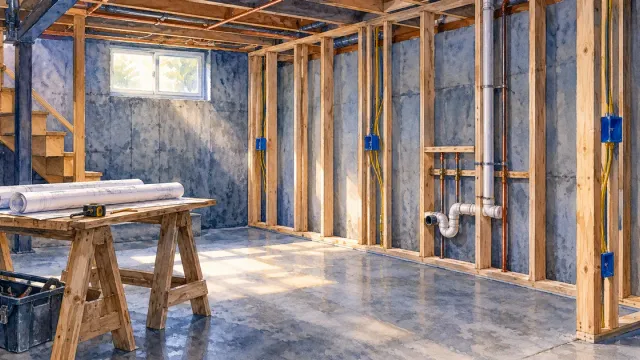
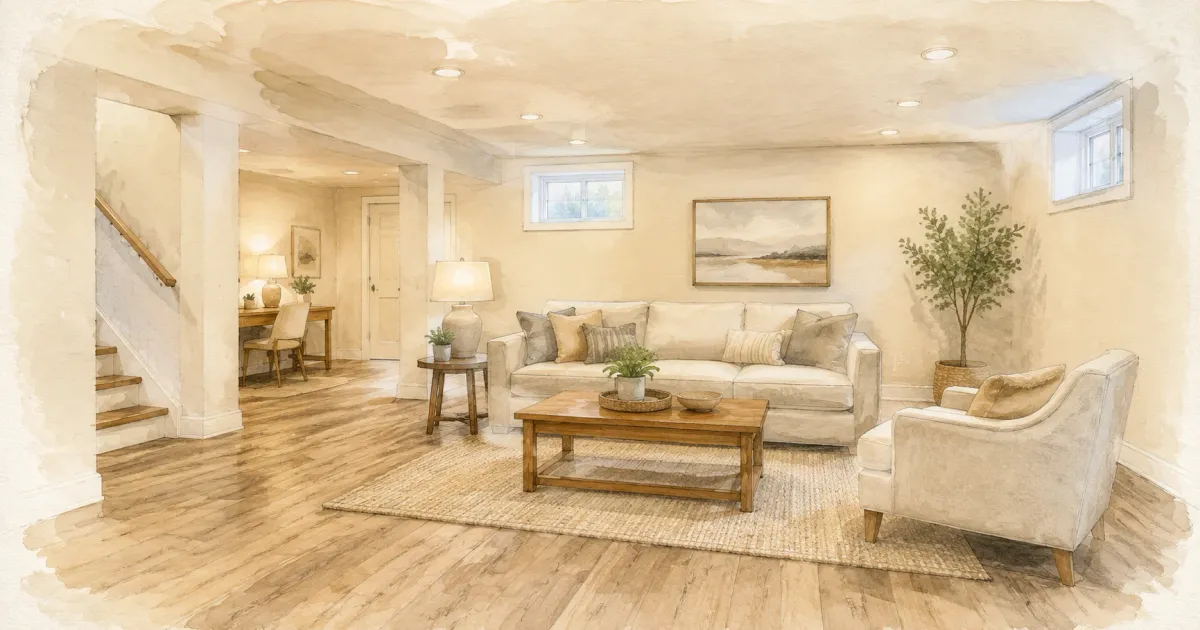
A finished basement is one of the most reliable ways to add value to a home — JLC's Cost vs. Value report puts the average ROI on basement finishing at roughly 86%, among the strongest returns of any interior remodeling project. But that number is an average across very different projects. How much of it you actually recoup depends on how the space is finished, whether the work is done to code, and how well it matches what buyers in your market expect.
- What Decides How Much Value You Recoup
- Walkout vs. Standard Basements
- Choose Flooring That Survives a Basement
- Solve Water Problems Before You Finish
- Get an Engineer Before You Remove a Wall
- Meet Minnesota's Ceiling Height Code
- Partially Finished Is Still a Real Value Add
- Frequently Asked Questions
What Decides How Much Value You Recoup
Appraisers and buyers generally treat basement square footage as worth less per square foot than main-level living space — it's below grade, and in most markets it doesn't count toward a home's official "above-grade" square footage on comps. That doesn't mean the work isn't worth it; it means the return depends heavily on execution rather than square footage alone.
The projects that hold their value share three traits: the finish level is proportional to the rest of the house (a builder-grade basement under a luxury main floor won't read as luxury, and the reverse wastes budget for buyers who won't pay for it), the space solves a real problem the local market already wants — a bedroom, a bathroom, genuine living space rather than a single open room — and the work is permitted and inspected, since an unpermitted finish can become a liability at resale rather than an asset. A six-figure walk-in-tub-style upgrade or a designer wet bar can be worth every dollar to live with, but appraisers credit them far less consistently than they credit a code-compliant bedroom or bathroom addition. If maximizing resale value is the goal, prioritize function and code compliance first, and treat the higher-end finishes as a bonus rather than the reason for the project.
Walkout vs. Standard Basements
A full walkout basement — one with windows and a door-level grade change to the backyard — brings in more natural light and adds a second point of entry and egress, both of which buyers notice immediately compared to a fully below-grade basement lit only by small windows. If your home already has a partial grade drop with room for a walkout conversion, it's usually the single highest-value structural change available in a basement remodel.
It's also the most expensive one. Converting a standard basement to a walkout means excavation, foundation work, and a new exterior door and stairway — a different category of project than finishing the interior of an existing basement. For most homes, it only pencils out when the site grading already makes it feasible; check with a contractor before assuming it's an option.
Choose Flooring That Survives a Basement
Basement floors sit directly on a concrete slab that's colder and more moisture-prone than a main-level subfloor, which rules out some flooring choices that work fine upstairs. Solid hardwood is a poor fit below grade for exactly that reason. The material that actually performs well in a basement is luxury vinyl plank (LVP) — it's genuinely waterproof rather than just water-resistant, floats over the slab without trapping moisture underneath, and holds up through the humidity swings a below-grade space sees over the year. Ceramic or porcelain tile is a solid second choice, particularly in a basement bathroom or utility area.
For a full breakdown of cost, durability, and DIY-friendliness across every basement flooring option, see our complete guide to basement flooring materials.
Solve Water Problems Before You Finish
If you've seen moisture from a foundation crack, efflorescence on the walls, or standing water after a heavy rain, resolve it before any finish work starts — flooring, drywall, and trim installed over an active moisture problem gets damaged and has to be redone, at real cost. It's also worth testing for radon before finishing, since a below-grade space is exactly where radon concentrates, and mitigation is far easier to plan for before walls and flooring go in than after.
Interior and exterior French drains and sump systems are the standard fix for chronic water intrusion, and the right one depends on how the water is entering and how much regrading or excavation you're willing to take on. This is a case where a proper diagnosis from a contractor or waterproofing specialist matters more than picking a fix off a list — the wrong system for your specific water source won't hold up.
Get an Engineer Before You Remove a Wall
Opening up a basement's floor plan is one of the more common ways to add both usable space and resale appeal, but any wall you're considering removing should be checked by a structural engineer first — some basement walls carry load from the floors above, and removing one without a proper beam or column in its place is a safety issue, not just a design one.
Whatever the layout ends up being, never permanently seal off access to mechanical systems, the electrical panel, or plumbing shutoffs. Service professionals need to reach them, and an appraiser or inspector will flag a basement where they can't.
Meet Minnesota's Ceiling Height Code
Ceiling height sets a hard limit on what a basement can legally become. Under Minnesota's state building code, habitable basement space needs a minimum of 7'0" of clear ceiling height for new construction, with an exception down to 6'4" for beams, girders, and ductwork in an existing basement finish. Fall short of that, and the room can't legally count as a bedroom or other habitable space — which matters directly for value, since a basement that becomes a legal fourth bedroom is worth more to an appraiser than the same square footage as an open rec room.
Lowering the basement slab to gain ceiling height is possible but expensive enough that it rarely makes financial sense on its own; in most homes, rerouting mechanical runs to clear the low points is the more cost-effective path. If you're finishing a basement bedroom specifically, see our full breakdown of Minnesota's legal basement bedroom requirements for the egress, ceiling height, and room-size rules together, and our basement ceiling ideas guide for how ceiling height should shape your material choice.
Partially Finished Is Still a Real Value Add
A full basement finish is a major undertaking, and it isn't the only way to add value. A partially finished basement — drywall, flooring, and lighting in the main area while mechanical or storage sections stay open — still converts unusable space into livable square footage, and it leaves the door open to finish the rest later without redoing what's already done. For homeowners working with a tighter budget, it's a legitimate way to capture a meaningful share of a full finish's value without the full cost.
We see this play out across the South Metro regularly — a Richfield basement that starts as a partial finish today is often the one that gets completed in a later phase once the rest of the house is settled.
Frequently Asked Questions
How much value does a finished basement add?
On average, homeowners recoup roughly 86% of the cost of a basement finish at resale, per JLC's Cost vs. Value report — one of the strongest returns of any interior remodeling project. The actual number for a specific home depends on the quality of the finish, whether it's permitted, and how well it matches the rest of the house.
Is a walkout basement worth more than a standard basement?
Yes. A walkout brings in more natural light and a second exit, both of which buyers and appraisers value over a fully below-grade space. It's also significantly more expensive to create if your home doesn't already have the grade for one.
What flooring is best for basement resale value?
Luxury vinyl plank (LVP) is the standard recommendation for most Minnesota basements — it's waterproof, holds up to humidity swings, and looks like hardwood at a fraction of the risk. Ceramic or porcelain tile is a strong second choice, especially in wet areas.
Do I need a permit to finish a basement in Minnesota?
Yes, for nearly any basement finish that adds walls, electrical, plumbing, or a bedroom. An unpermitted finish is a liability at resale, not an asset — it can hold up a sale or trigger a price reduction when it surfaces during inspection.
What ceiling height do I need for a legal basement bedroom in Minnesota?
At least 7'0" of clear ceiling height for new construction, with an exception down to 6'4" under beams, girders, and ductwork in an existing basement finish. Below that, the space can't legally count as a bedroom.
If you're weighing what a basement remodel would actually be worth for your home, contact us — we can walk your specific space and give you a realistic read on cost, code requirements, and the finish level that makes sense for your neighborhood.