Most showers give you clear warning before they fail. The trouble is that the early signs — a hairline crack in the grout, a patch of mold that scrubs away and returns a month later, a pan that flexes slightly underfoot — look like maintenance items rather than symptoms. By the time water damage is visible on the ceiling below, the repair has usually stopped being a repair.
The question worth answering is not whether your shower looks tired. It is whether the assembly behind the tile is still keeping water where it belongs. This guide covers six signs that a shower or tub surround has reached the end of its service life, how to decide between fixing and replacing, and what a replacement actually involves.
- Broken or Loose Tiles
- Mold That Keeps Coming Back
- Leaks, Visible and Hidden
- A Shower Pan That Moves
- Rust and Hard Water Damage
- A Shower That Looks Dated
- Repair or Replace: How to Decide
- What a Shower Replacement Actually Involves
Broken or Loose Tiles
Cracked or loose tile is almost never a surface problem. Tile is rigid, and it cracks when the substrate behind it moves — which usually means the backer board has absorbed water and softened, or the framing beneath it has shifted. A single chipped tile from a dropped shampoo bottle is cosmetic. Several cracked tiles, tiles that sound hollow when you tap them, or grout lines that keep opening after you repoint them are structural.
Press on the wall in a few places. If it gives at all, water has gotten behind the tile and the backer is failing. In houses built before the mid-1990s this is common, because the standard assembly of that era was tile over water-resistant drywall — green board — with no waterproof membrane behind it. Green board slows water down. It does not stop it. Once it's saturated, the only real fix is opening the wall.
Sharp broken edges are worth mentioning for a simpler reason: they cut, and they shred washcloths and towels. If you have small children, that alone justifies moving quickly.
Mold That Keeps Coming Back
Mold that returns within weeks of a thorough cleaning is telling you there is a moisture source you haven't addressed. Surface mold on grout wipes away and stays away in a well-ventilated bathroom. Mold that reappears in the same spot is being fed — usually by water trapped behind tile, or by humidity that never leaves the room.
The EPA is direct about this: the key to mold control is moisture control, and water-damaged areas need to dry within 24 to 48 hours to prevent growth. A shower that stays damp for hours after use fails that standard every single day.
Minnesota bathrooms are particularly prone to it. Through the winter our homes run dry heat while showers pump humid air into a sealed room, and that swing between saturated and arid is hard on grout, caulk, and paint. An undersized exhaust fan — or one ducted into an attic instead of outside, which we find more often than you'd expect — turns a well-built shower into a mold problem within a few years. Before replacing a shower for mold, confirm the ventilation is right, or you will have the same conversation about the new one. Our post on bathroom exhaust and venting codes in Minnesota covers what the code requires and where installations typically go wrong.
Mold spreading beyond the shower enclosure — onto adjacent walls, the ceiling, or the floor outside the curb — is a sign that water is moving inside the wall cavity, not just sitting on the surface. That is a replacement conversation, not a cleaning one.
Leaks, Visible and Hidden
A dripping showerhead or a leaking valve is a plumbing repair. The leaks that force a replacement are the ones you never see directly, and they announce themselves somewhere other than the bathroom.
Watch for discoloration or soft spots on the floor just outside the shower, staining on the ceiling of the room below, a musty smell that persists, or flooring that has started to cup or lift near the base of the shower. Any of those means water has been escaping the enclosure for a while. Pan liners fail at the corners and at the drain connection, and once the liner is compromised, every shower sends water into the subfloor.
This is the sign to act on fastest. A failed pan liner does not get worse gradually — it gets worse every time someone showers, and the cost curve runs from a shower replacement to a shower replacement plus subfloor, framing, and ceiling repair below.
A Shower Pan That Moves
If your shower floor flexes underfoot, replace it. A properly installed pan does not move, whether it's a mortar bed or an acrylic base set in a full mortar bearing.
Movement in an acrylic or fiberglass base almost always means it was installed without adequate support beneath it — a common shortcut, and one that shows up years later. The base deflects with every use, and that flexing breaks the seal at the drain and cracks the caulk joint at the wall. Water then runs behind and beneath the base, where nothing stops it.
Movement is also worth checking proactively, before there's any visible damage. Step into the shower and shift your weight around, particularly near the drain and at the perimeter. If you feel any give at all, the assembly is working against itself and it is only a matter of when.
Rust and Hard Water Damage
Rust on a glass door frame or fixture is corrosion, and corrosion is structural once it reaches the fasteners. Framed shower doors carry their weight through that metal, and a frame that has been rusting at the bottom track for a decade can fail suddenly with a panel of glass in it.
Much of the Twin Cities south metro is served by genuinely hard groundwater, and it takes a toll that homeowners often mistake for age. Mineral scale etches glass permanently, clogs showerheads and valve cartridges, and accelerates the breakdown of chrome and nickel finishes. Glass that stays cloudy after a proper cleaning is not dirty — it is etched, and no product will restore it. Homeowners we work with on bathroom remodeling in Rosemount and the surrounding communities frequently pair a shower replacement with a water softener for exactly this reason, because otherwise the new fixtures follow the old ones.
A Shower That Looks Dated
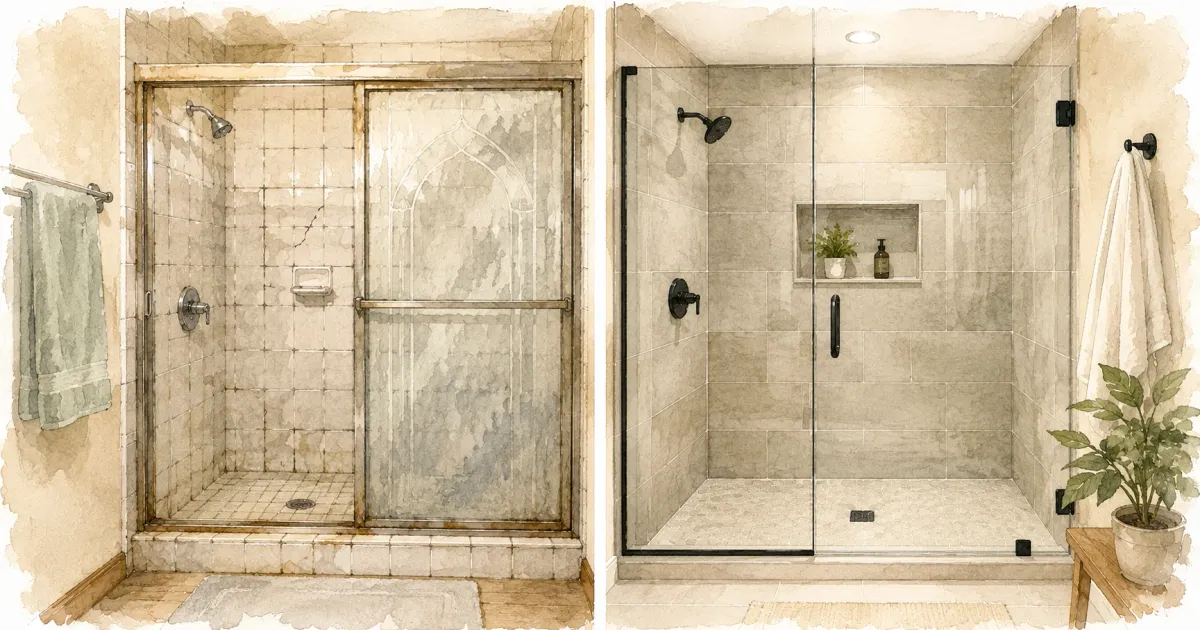
A shower can be structurally sound and still be worth replacing. If yours has a low-slung fiberglass surround, small mosaic floor tile with grout that never looks clean, a framed door in polished brass, or the beige-on-beige palette of a 1990s builder-grade bath, it is dragging down the room around it — and it will be one of the first things a buyer notices.
Dated showers also tend to be small ones. Standard enclosures of that era ran 30 by 30 inches or 32 by 32, which meets code but feels cramped to most adults. If you are opening the walls anyway, gaining even a few inches, or converting a rarely used tub into a larger walk-in shower, changes how the room feels far more than new tile alone will. Our tiled shower ideas post is a good starting point for what's possible.
Aesthetics are also a reasonable moment to build in features that are expensive to add later — a curbless entry, a bench, or blocking in the walls for future grab bars. Those cost very little during a replacement and a great deal afterward.
Repair or Replace: How to Decide
The dividing line is whether the waterproofing layer is intact. Anything on the surface can be repaired. Anything that has compromised the membrane, the pan liner, or the substrate behind the tile means the assembly has to come out.
| What you're seeing | Likely fix | Typical cost |
|---|---|---|
| Cracked or missing grout, failing caulk | Repair — repoint and re-caulk | $200–$600 |
| Dripping head or valve, low pressure | Repair — replace cartridge or fixture | $250–$900 |
| One chipped tile, no movement or hollow sound | Repair — spot tile replacement | $300–$800 |
| Rusted door frame, etched glass | Partial — new door and hardware | $900–$2,500 |
| Multiple cracked or hollow tiles, soft wall | Replace — waterproofing has failed | $6,000–$12,000 |
| Pan movement, recurring mold, staining below | Replace — pan liner or substrate has failed | $7,000–$15,000 |
| Any of the above plus a layout change | Full bathroom remodel | $18,000–$35,000+ |
Ranges reflect typical Twin Cities pricing for a standard-size shower and will shift with tile selection, plumbing relocation, and what's found once the walls are open.
If you're weighing a repair that runs more than a third of what replacement would cost, replace. Repairs to a failing assembly buy time measured in months, and the money doesn't carry forward.
What a Shower Replacement Actually Involves
A straightforward shower replacement runs one to two weeks of active work, and follows a fairly fixed sequence: demolition down to the studs, inspection of framing and plumbing, any rough plumbing or electrical changes, new backer board and waterproofing membrane, pan installation, tile setting, grout and cure time, then glass and fixtures. Tile cannot be rushed — thinset and grout each need to cure, and pushing that schedule is how installations fail early.
Two steps matter more than the rest. The first is the waterproofing membrane, which is the actual barrier keeping water out of your framing; tile and grout are finish materials and are not waterproof on their own. The second is the pan and its slope to the drain, which has to be right before anything goes over it.
Permitting depends on scope. Replacing a shower in place with no plumbing changes may not require one, but relocating the drain, moving a wall, or altering electrical does — and requirements are set city by city under the Minnesota State Building Code. Your contractor should pull the permit and schedule inspections. If you'd like a fuller picture of the planning process before you start, our guide on how to plan a bathroom remodel walks through budgeting, hiring, and scheduling.
Frequently Asked Questions
How long does a shower last?
A well-built tiled shower with proper waterproofing should last 20 to 30 years or more. Acrylic and fiberglass units typically run 15 to 20. Showers built before waterproof membranes became standard practice — roughly pre-1995 in most Minnesota housing — often begin failing well before that.
Can I just replace the shower without redoing the whole bathroom?
Yes, and it's common. A shower replacement is self-contained as long as the layout stays the same. Expect some adjacent work regardless, since demolition usually disturbs flooring and drywall at the perimeter of the enclosure.
How much does it cost to replace a shower in Minnesota?
Most full shower replacements in the Twin Cities fall between $6,000 and $15,000, depending on size, tile selection, glass, and whether plumbing moves. Converting a tub to a walk-in shower generally lands in the upper half of that range.
Is black mold in my shower dangerous?
Mold in a bathroom can produce allergens and irritants and can trigger asthma symptoms, per the EPA. Surface mold on grout is manageable with cleaning and better ventilation. Mold that keeps returning, or that has spread beyond the enclosure, indicates trapped moisture and needs the source addressed rather than the surface cleaned.
Do I need a permit to replace a shower?
Not usually, if it's a like-for-like replacement with no plumbing or electrical changes. Moving the drain, relocating a wall, or adding circuits does require one. Requirements vary by city, and your contractor should handle the application.
Your Minneapolis Bathroom Remodeling Contractor
When a shower needs replacing, most of the work that determines whether it lasts happens behind the tile, where you'll never see it. That's where a contractor's standards actually show. Honey-Doers has more than twenty years of experience helping Twin Cities families with shower and bathroom renovations, and we bring the same attentiveness, integrity, and craftsmanship to a single shower replacement as we do to a whole-home project. Read more about our team and how we work.
If you're seeing any of the signs above and want an honest read on whether you're looking at a repair or a replacement, contact us today for a free estimate.