A full attic insulation job in Minnesota cost $4,475 to $8,600 across a sampling of our jobs around the metro since 2023, with full attics air sealed and blown in to R-50. Smaller attic work, like fixing the eaves or covering an insurance allowance, came in at $1,215 to $2,200. Those are the attic lines from our own invoices, not a national average. What moved the price most was not the size of the attic. It was whether the old insulation could stay.
The other half of the cost question is what you get back. The federal tax credit that covered insulation ended for work placed in service after 2025, and Minnesota's new state rebates have not launched. Utility rebates from CenterPoint Energy and Xcel Energy are still paying, with conditions that decide whether you collect.
- What Our Attic Insulation Jobs Have Cost
- What Makes an Attic Cost More
- Other Insulation Work and What It Cost
- Rebates and Tax Credits in 2026
- How Much Insulation a Minnesota Attic Needs
- Frequently Asked Questions
What Our Attic Insulation Jobs Have Cost
Here is a sampling of our attic insulation work since 2023, from $1,215 for a small repair to $8,600 for a full tear-out, each with its scope (measured, from our JobTread records; prices are the approved line for the insulation work, not the whole project).
| Year | Where | Scope | Price |
|---|---|---|---|
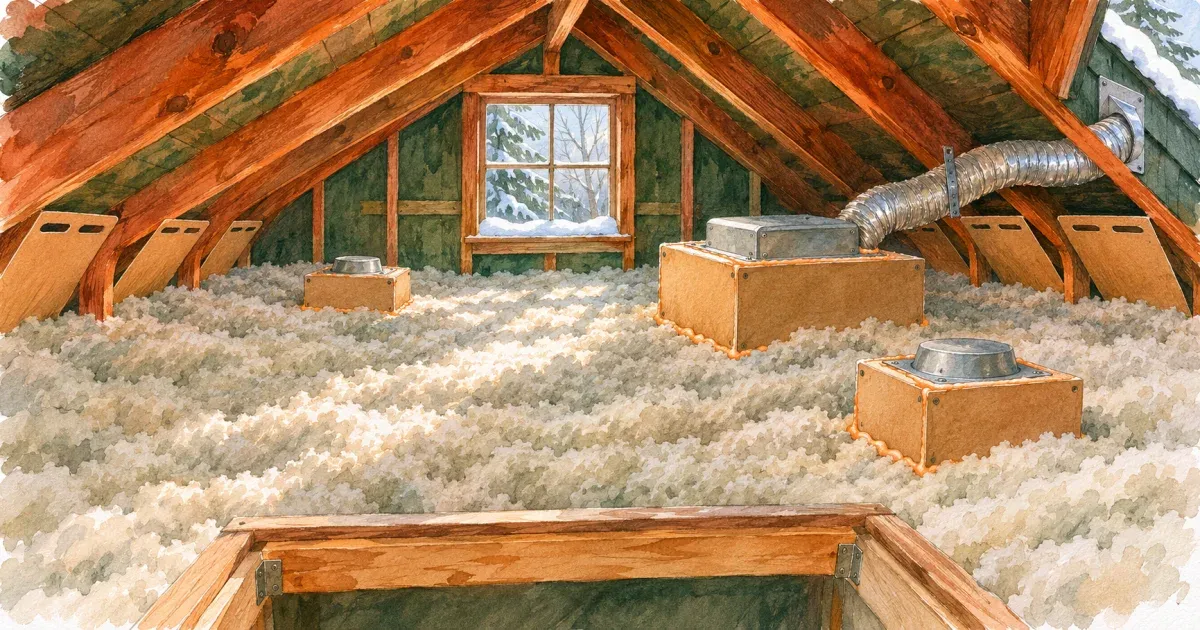
| 2023 | Lakeville | Removed all existing insulation, built insulated boxes around openings, foamed every fan, vent and receptacle, blew in to R-50 | $8,600 |
| 2023 | Rosemount | Attic insulation and ventilation corrections, added to a siding project | $4,500 |
| 2023 | Lakeville | Boxed and foamed the exhaust fan vents, added air chutes, sealed the attic hatch, blew in to R-50 over the existing layer | $4,475 |
| 2024 | Lakeville | Replaced the chutes in the soffits, re-insulated the eaves where wind had blown insulation back | $2,200 |
| 2023 | Lakeville | Attic insulation and chutes after ceiling damage, priced from the insurance scope | $1,215 |
Read the range as a reference point, not a quote. It does answer the question most homeowners have once they hold a bid: is $5,000 to $6,000 normal for bringing an attic up to current levels here? On our jobs, a full attic with the old insulation left in place came in under $5,000, and one that had to be stripped first came in near $9,000.
We price attic work by scope, not by the square foot. Two attics of the same size can need very different amounts of sealing, and that work is where the labor goes.
What Makes an Attic Cost More
Removing the old insulation is the biggest single cost jump. The $8,600 Lakeville attic needed everything pulled out first, because water had been getting in for a while. "Poor ventilation played a part," Adam Berres said of that job, "but the bulk of the moisture discovered in the attic could be attributed to intrusions": a broken truss that had settled, plus failed sealant around the roof accessories and the fireplace. Wet insulation does not insulate, and it cannot stay. On the $4,475 job, the existing layer was dry and stayed put, and new insulation went on top of it.
After removal, these are the things that add time and material to an attic bid:
- Air sealing. Every bath fan, recessed light, plumbing vent and wire hole in the ceiling is a path for warm, moist air into the attic. We build boxes around fans and light housings and foam the gaps before any insulation goes in. More penetrations means more hours.
- Chutes at the eaves. Chutes (also called baffles) hold insulation back from the soffit vents so air can still move along the underside of the roof. Missing or crushed chutes are common, and the $2,200 job above was almost entirely chute and eave repair.
- Ventilation fixes. When the inspection turns up blocked or missing vents, they are corrected in the same visit. Adam's view from our inspections is that plenty of homes have soffit vents already, "but the attic wasn't properly insulated & it negates the ventilation." The sealing and insulation have to come first for the vents to do their job.
- What is in the old insulation. Loose, pebble-like vermiculite, found in many older Minnesota homes, can contain asbestos and should be tested before anyone disturbs it. Our guide to old-home hazards covers what that test involves.
If you have ice dams, the attic is usually where the money should go before the roof. Our ice dam guide walks through the order that works: seal the air leaks, add insulation, then check the ventilation. Our post on checking roof ventilation covers the last step.
Access matters less than people expect. A tight attic hatch slows the crew down, but it rarely moves a bid as much as removal or a long list of ceiling penetrations does.
Other Insulation Work and What It Cost
Insulation also shows up inside bigger projects, and those lines give a sense of the smaller jobs. These come from the same records (measured):
- Between floors: In Burnsville in 2025, we blew 18 inches of cellulose into the floor cavity between the first floor and the lower level, added batts and new drywall on the mechanical room walls, and patched the walls after HVAC work, for $9,800.
- Garage walls: New batt insulation and a taped vapor barrier on an Edina garage's walls ran $1,100, as part of replacing the garage drywall.
- A basement wall after mold: Opening a Lakeville basement wall, replacing the moldy vapor barrier and insulation, and hanging new drywall ran $1,300 in 2025.
- A utility room: Insulating a Burnsville utility room was a $450 line on a 2024 change order.
- Bath fans: In Lakeville this fall, new exhaust fans with proper ducting, venting and insulation were priced at $950 each.
Two of those jobs ended with a credit, and they show how we price insulation. On the Lakeville fans, the attic needed less venting and insulation work than we planned for, so $600 came back to the homeowner. On a St. Paul kitchen and four-season porch remodel, we had $4,000 in the contract to insulate the porch. When the walls came open, the insulation was already there, so none was added and the $4,000 was credited.
Rebates and Tax Credits in 2026
The federal tax credit is gone, the state program has not started, and the utility rebates are what remain. Here is where each one stands as of November 2026.
The federal credit ended with 2025. The Energy Efficient Home Improvement Credit paid 30% of insulation costs, up to $1,200 a year. The IRS says it only applies to improvements made through December 31, 2025. Work finished in 2025 can still be claimed on your 2025 return; work done in 2026 cannot.
Minnesota's state rebates have not launched. The Home Efficiency Rebate program (HOMES) lists air sealing and insulation as eligible upgrades, with rebates tied to modeled energy savings and household income. As of the Commerce Department's October 2026 update, the program is still waiting on federal approval with no launch date. Be wary of anyone who calls offering to sign you up for it.
Utility rebates are paying now. Which one you can use depends on who supplies the fuel that heats your house.
| Utility | What qualifies | Rebate |
|---|---|---|
| CenterPoint Energy (gas heat) | Attic air sealing, with blower door tests before and after | $750 |
| CenterPoint Energy (gas heat) | Air sealing plus attic insulation raised from R-30 or less to R-49 or more | $1,300 |
| CenterPoint Energy (gas heat) | Attic insulation without air sealing | None |
| Xcel Energy (Xcel gas or electric heat) | Air sealing with attic or wall insulation, at least a 15% leakage reduction | 40% of cost, up to $600 |
| Xcel Energy (Xcel gas or electric heat) | Attic insulation from R-19 or less to R-49 or more, with air sealing | 40% of cost, up to $1,200 |
CenterPoint also pays $1,500 for qualifying wall insulation and $200 for rim joist insulation added to an attic or wall project, up to $3,000 a home (CenterPoint program page). Homes where Xcel supplies only the electricity and air conditioning get much smaller amounts, $120 for the attic (Xcel's 2024 to 2026 rebate summary).
Both programs tie the attic rebate to air sealing, and both require their own approved installers. CenterPoint publishes a list of rebate-eligible installers on that page, and Xcel requires a participating contractor. If the crew doing your attic is not on the list, the rebate is not available, however good the work is. Ask before you sign. CenterPoint also wants the application in by December 31 of the year the work is done, and Xcel's current rebate sheet runs through 2026, so check for its 2027 version before planning a winter job.
How Much Insulation a Minnesota Attic Needs
Most Minnesota attics should be insulated to R-49 or R-60. The Twin Cities sit in climate zone 6, and ENERGY STAR's retrofit guidance is R-60 for an attic with no insulation and R-49 for one that already has three to four inches. R-49 is also the bar both utilities use for their rebates.
A quick check: if you can see the tops of the ceiling joists from the attic hatch, there is not enough. Our jobs blow in to R-50, which clears the rebate threshold with a little margin for settling.
Minnesota winters make this matter more than in most of the country. Heat leaking into the attic is what melts the snow that refreezes at the eaves, so an under-insulated attic shows up first as ice dams and water stains, and only later on the heating bill. That is also why we look at the attic on roofing calls, and why smaller insulation repairs come through our home maintenance work.
Frequently Asked Questions
How much does it cost to insulate a 1,500 square foot attic?
We don't price attics by the square foot, so we don't have a per-foot number from our own jobs. Our full attic jobs to R-50 ran $4,475 to $8,600, and the spread came from what had to happen before the new insulation went in, mostly removal and sealing, more than from size.
What is the cheapest way to insulate an attic?
Adding blown-in insulation over a dry existing layer is the least expensive full upgrade, because nothing has to come out. Pair it with air sealing. Insulation laid over open gaps still lets warm, moist air through, and air sealing is also what unlocks the utility rebates.
Do I need to remove old insulation before adding more?
Only if it is wet, moldy, contaminated by animals, or might be vermiculite. Dry insulation in decent shape can stay, and new insulation goes on top. Removal was the reason our most expensive attic cost nearly twice as much as a similar one.
Can I still get a rebate for attic insulation in Minnesota?
Yes, from your utility, if the work includes air sealing and is done by an installer on their list. CenterPoint pays up to $1,300 for attic air sealing with insulation, and Xcel pays 40% of the cost up to $1,200 for the attic. The federal tax credit ended for work after 2025, and the state HOMES rebates have not launched.
Is attic insulation worth it in Minnesota?
For most older homes, yes. An attic below R-30 is losing heat every winter day, and that heat is what causes ice dams. If you're also planning a roof, insulate before or with the reroof; our roof replacement cost guide covers that side.
If your attic hatch shows bare joist tops, or ice dams keep coming back, we can look at the attic, tell you what needs sealing, and price it by scope. Contact us to set up a visit.