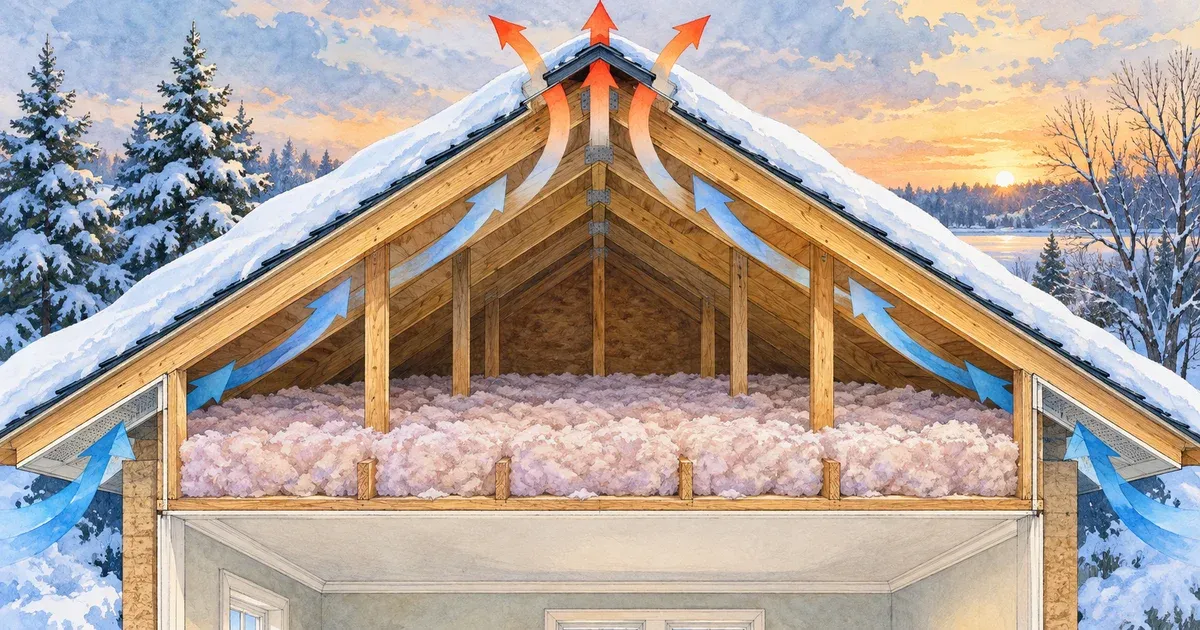
Roof ventilation works by moving air continuously through the attic — cool, dry air in low through soffit vents, warm, moist air out high through a ridge or roof vent. When that airflow is blocked or undersized, the attic traps heat in summer and moisture year-round, and in Minnesota, an under-ventilated attic is one of the most common hidden causes of ice dams.
Most homeowners never think about attic ventilation until a symptom shows up somewhere else — a mysteriously high winter heating bill, ice buildup along the eaves, or a musty smell that will not go away. By the time any of those show up, the ventilation problem has usually been developing for a while.
- How Roof Ventilation Actually Works
- The Main Types of Roof Vents
- Signs Your Roof Isn't Ventilated Properly
- How to Check Your Own Attic
- Why This Matters More in Minnesota
- Frequently Asked Questions
How roof ventilation actually works
A ventilated attic depends on a balanced pair: intake vents low on the roof (usually at the soffits) pull in fresh outside air, and exhaust vents high on the roof (a ridge vent, box vents, or a gable vent) let warm, moist air escape. Neither half works well without the other — exhaust vents with no intake just recirculate the same air, and intake vents with no exhaust have nowhere to push the warm air they're displacing.
That constant airflow does three jobs at once: it keeps attic temperature closer to outside air rather than building up trapped heat, it carries moisture out before it can condense on framing or insulation, and — critically for this climate — it keeps the underside of the roof deck cold and even, rather than warm in spots where heat is escaping from the living space below. ENERGY STAR identifies attic air sealing and ventilation as one of the higher-impact home upgrade categories for exactly this reason — it affects both energy loss and moisture control at the same time, not just one or the other.
The main types of roof vents
Most roofs use some combination of these, and the right mix depends on the roof's shape and attic layout more than personal preference.
| Vent type | Function | Location | Notes |
|---|---|---|---|
| Soffit vents | Intake | Under the eaves | The intake half of the system — often undersized or painted over on older homes |
| Ridge vents | Exhaust | Along the roof peak | Continuous airflow the full length of the ridge; pairs well with soffit intake |
| Box/static vents | Exhaust | Scattered near the peak | Simple and passive, but less continuous than a ridge vent |
| Gable vents | Exhaust (cross-flow) | Exterior wall peaks | Common on older homes; can work against a ridge vent if both are present without a baffle |
| Turbine vents | Exhaust | Roof peak | Wind-powered, more airflow in breezy conditions, little to none in still air |
| Powered vents | Exhaust | Roof peak | Electric or solar-powered; useful where passive venting can't move enough air, but adds a component that can fail |
The most common setup on newer construction is a continuous ridge vent paired with continuous soffit vents — simple, passive, and effective as long as nothing is blocking the soffit intake. Gable vents combined with a ridge vent is a configuration worth checking closely, since without a baffle to separate them, the ridge vent can end up pulling air from the closer gable vent instead of from the soffits, short-circuiting the intended airflow path.
Signs your roof isn't ventilated properly
Poor ventilation rarely announces itself directly — it shows up as a handful of related symptoms that are easy to blame on something else.
Ice dams forming along the eaves in winter are the clearest Minnesota-specific sign, since they mean attic heat is escaping into the roof deck and melting snow unevenly. An attic that feels noticeably hotter than the outside air on a summer afternoon points to inadequate exhaust. Visible moisture, frost, or mold on the underside of the roof deck or on attic framing means humid air is not getting out fast enough. Peeling paint or damaged wallpaper on an upper-floor ceiling, without an obvious roof leak, can also trace back to trapped attic moisture working its way down. And unusually high heating or cooling bills, with no other explanation, often mean the attic is fighting the HVAC system instead of helping insulate against it.
One or two of these signs alone can have other causes. Ice dams plus a noticeably hot or musty attic together is a much stronger signal that ventilation, not just insulation or flashing, is the root issue.
How to check your own attic
A basic check starts with a visual inspection from inside the attic on a day with reasonable weather. Look for blocked soffit vents — insulation pushed too far toward the eaves is one of the most common culprits, since it physically covers the intake opening from the inside. Check that ridge, box, or gable vents are clear of debris, nesting material, or paint buildup from the outside as well.
A simple thermometer and hygrometer left in the attic for a few hours gives a more objective read than a visual check alone. On a moderate day, attic temperature should stay reasonably close to outside air rather than climbing well above it, and relative humidity should generally stay below 60%. Readings well outside those ranges are a sign the intake/exhaust balance is off, even if nothing looks visibly wrong.
If the check turns up blocked vents, insufficient vent area for the attic's size, or a vent configuration working against itself (like an unbaffled gable vent fighting a ridge vent), that is the point to bring in a professional rather than guess at a fix — undersized or mismatched ventilation is a sizing and configuration problem, not something a single added vent usually solves on its own. A roofing inspection can confirm the actual intake-to-exhaust ratio your attic needs.
Why this matters more in Minnesota
Attic ventilation is one of the two things that determine whether a Minnesota roof develops ice dams — insulation is the other, and they work together rather than substituting for each other. Heat escaping into a poorly ventilated attic warms the underside of the roof deck unevenly, melting snow higher up the roof even while the eaves stay cold. That meltwater refreezes at the colder eave edge and forms the ice dam, then backs water up under shingles toward flashing and roof-deck seams that were never meant to hold standing water. University of Minnesota Extension names air sealing, attic insulation, and ventilation as the three combined factors that prevent ice dams from forming in the first place — ventilation alone helps, but it works best paired with the other two.
This is also why ventilation and insulation get evaluated together, not separately. A well-ventilated attic with too little insulation still lets heat escape into the roof deck; a heavily insulated attic with blocked vents traps the moisture that insulation alone can't handle. Homes around Eden Prairie and similar established South Metro neighborhoods, many built before current ventilation standards were common, are frequently found to have one half of that pairing without the other.
Frequently asked questions
How do I know if my attic has enough ventilation?
Check attic temperature and humidity on a moderate day — temperature should stay reasonably close to outside air, and humidity should generally stay below 60%. Persistent ice dams, a noticeably hot attic in summer, or visible moisture on the roof deck are practical warning signs even without instruments.
Can too much roof ventilation be a problem?
It's uncommon, but an imbalanced system — much more exhaust capacity than intake, or vents fighting each other like an unbaffled gable vent against a ridge vent — can actually pull conditioned air from the living space instead of moving outside air through the attic. Balance between intake and exhaust matters more than total vent count.
Does roof ventilation prevent ice dams?
Proper ventilation is one of the two main factors that prevent ice dams, alongside attic insulation. Ventilation keeps the roof deck evenly cold so snow melts uniformly (or not at all) rather than melting higher up the roof and refreezing at the eaves.
How much does it cost to add roof ventilation?
Cost depends heavily on what's already there — adding soffit vents to a roof that already has a ridge vent but blocked intake is a much smaller project than installing a full ridge-and-soffit system where none exists. A roofing inspection can scope the actual work needed rather than guessing from a general estimate.
Roof ventilation is easy to overlook because the vents themselves are barely visible from the ground, but the airflow behind them affects everything from your heating bill to whether ice dams form every winter. If you're seeing any of the warning signs above, contact us to have your attic's ventilation checked before another Minnesota winter puts it to the test.