Spring cleaning is here, and this year you've decided to step it up: a basement remodel. Plenty of homeowners have a basement they don't take full advantage of, and the price of finishing it is often what holds them back.
A finished basement is one of the more reliable ways to add both value and everyday living space to a home. Before your basement remodeler arrives, though, a little prep work goes a long way. Don't wait to clean up your basement any longer — these steps will make the walkthrough smoother and can help you avoid prep-related fees once the project starts.
Sorting and Storage
Basements tend to collect nearly everything a household doesn't need but can't quite part with. Storage is a legitimate use of the space, but before a remodel it's worth being conscientious about how much of that space you actually need to keep.
A short list of what's genuinely worth storing in a basement:
- Offseason clothes
- Holiday or party decorations
- Offseason outdoor equipment
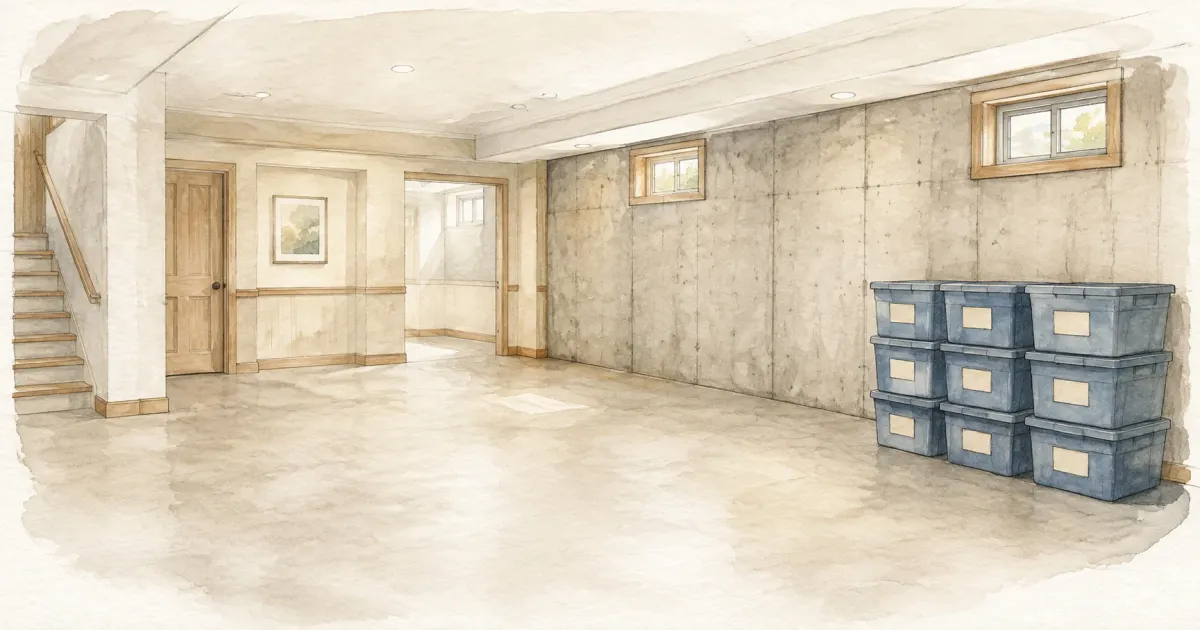
Seal anything you're keeping down there in bins to protect it from moisture, rot, and pests, and get rid of anything that's just taking up floor space. If you haven't touched a box in two winters, it's a safe bet to donate or toss it rather than move it around a construction zone.
Inspect for Damage
Basements are prone to water intrusion, and most homeowners don't realize the extent of it until it requires significant repair. Clearing the space out before a remodel gives you a rare chance to actually see the walls, foundation, and flooring underneath everything that's been stored against them for years.
Check the walls, the foundation, any carpeting, and behind cabinets for staining, efflorescence (the chalky white residue mineral deposits leave behind), or soft spots. If you find cracks, flag them for your basement remodeler before framing or finishing work covers them up — sealing a crack is far cheaper before drywall goes up than after.
While you're at it, wipe the walls down. Homeowners often skip walls entirely when cleaning, but they collect the same everyday grime as countertops and doorknobs.
Deep Cleaning
It's tempting to assume the remodeling crew will handle prep cleaning as part of the job, but most contractors price extra fees into a job that starts in an unkempt space — cleanup that isn't part of the actual remodel eats into the schedule they've quoted.
Focus on what you can reasonably do yourself, and be upfront with your basement remodeler about anything you weren't able to get to. Deep cleaning matters most if you're planning wall or floor paneling, or a modular ceiling system — those installations go directly over existing surfaces, so anything left behind (dust, mildew, old adhesive) gets sealed in rather than cleaned up.
Use a cleaner formulated to kill mold on contact, not just mask the smell, so you're not sealing spores behind new finishes.
Moisture and Fixture Cleaning
Moisture is the one thing that consistently undermines basement remodels. Running a dehumidifier or air conditioner helps, but cleaning around the furnace, water heater, and laundry units also matters — dust and lint buildup around these appliances traps humidity near the surfaces you're about to finish.
A simple way to check for excess moisture: tape a square of plastic sheeting (roughly the size of a bath mat) to the floor and another to a wall, and leave both in place for about two weeks. Condensation on the underside of the plastic means the surface itself is damp; droplets on top mean the air in the room is too humid. Either result is worth mentioning to your remodeler before finishing materials go in — the EPA's radon guidance for homes is also worth a look here, since a basement remodel is a natural point to test or retest if it's been a few years.
A basement remodeling crew will generally advise against wall treatments or new carpet over a space with active moisture or water damage — finishing over the problem just traps it. Clean the filter and blower on your furnace to help with humidity in the short term, and consider a standalone dehumidifier for anything beyond that.
Consider the Extent of Your Basement Remodel
How much you need to clear out depends on the scope of the project. A full basement remodel — new layout, new systems, floor to ceiling — usually means clearing the space completely. Updating a single existing room within the basement is a lighter lift: prep only that area.
Talk through the scope with your basement remodeler before you start cleaning, since it changes what "ready" actually looks like. For a partial remodel, clear the specific space of furniture and stored items so the crew has clean access to that room. For a full remodel, it's also worth cleaning the air vent ducts — reducing dust and moisture there helps the rest of the space stay drier once work begins.
If your home was built before 1978, flag that for your remodeler too — the EPA's Lead-Safe Renovation rule requires lead-safe work practices any time a renovation disturbs painted surfaces, and it's worth knowing before demo starts, not after.
This kind of prep isn't unique to any one neighborhood, either — a lot of Shakopee's housing stock dates to an era when basements were treated purely as storage and mechanical space, so a first-time remodel there often starts with exactly this kind of clear-out.
Conclusion
Cleaning your space before a remodeler arrives is about more than tidiness — it surfaces problems (water damage, mold, humidity) while they're still cheap to fix, and it keeps prep fees off your final bill. Deep clean, clear the clutter, inspect for signs of water damage, and put your remaining effort into whichever part of the basement the remodel will actually touch. From there, our basement remodeling team can take it from a cleared-out space to a finished one.