A small walk-in closet works when it is planned around two measurements: about 24 inches of depth for anything that hangs, and at least 24 inches of clear aisle to walk and turn in. Get those right and a closet as narrow as 4 feet can hold a full wardrobe. Get them wrong and even a large closet ends up with clothes brushing the opposite wall and drawers that cannot open.
The ideas below start with those numbers, then work through the storage choices that make the most of a tight footprint. The photos are from closets we built in Apple Valley and Elko New Market. At the end there is a one-page measuring worksheet to fill in before you buy a system or call a contractor.
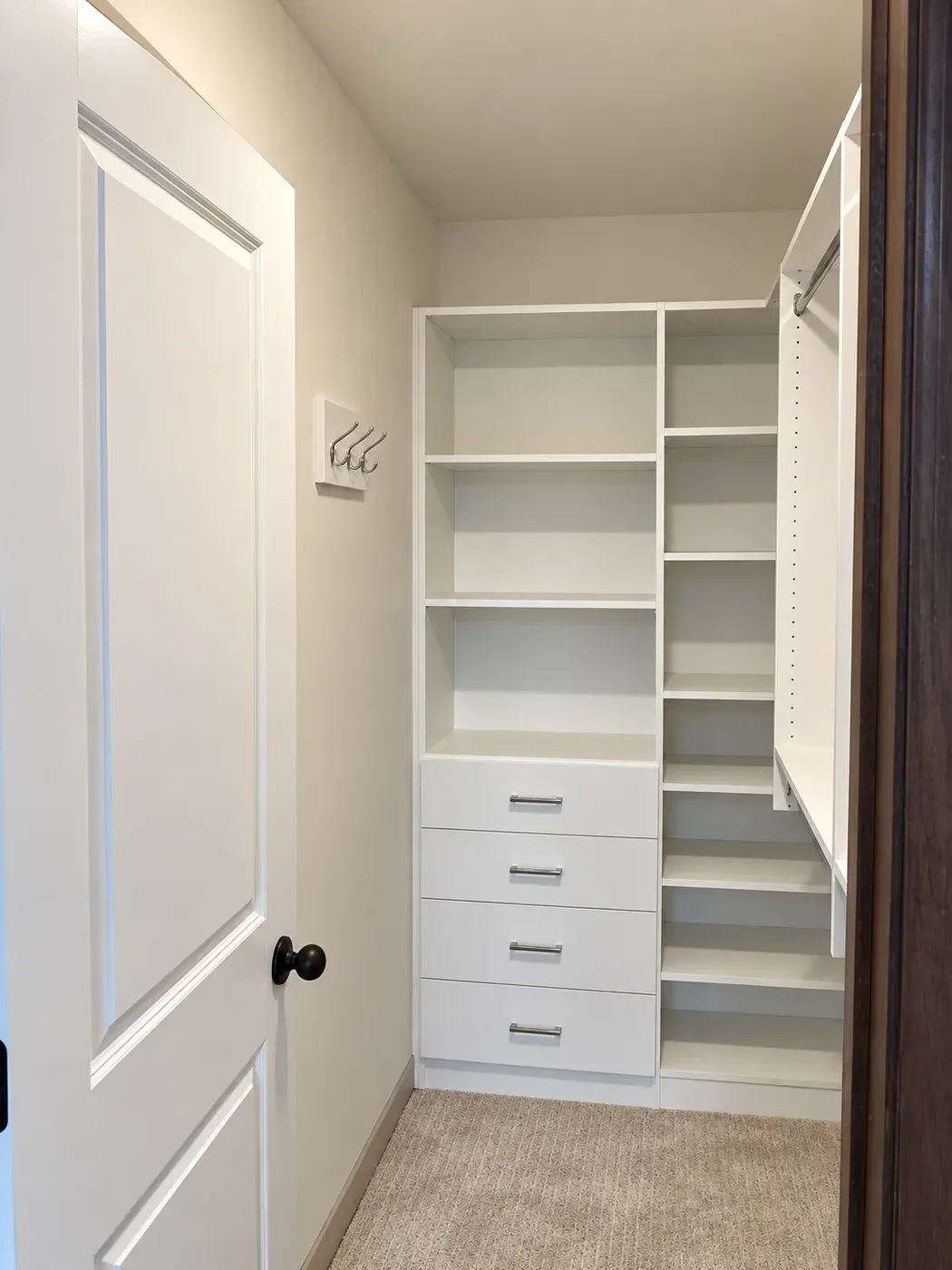
A narrow walk-in in Apple Valley: a drawer stack and shelf tower on the end wall, with hanging on the wall opposite the door swing.
- How Small Can a Walk-In Closet Be?
- Double the Hanging Space with Stacked Rods
- Put a Shelf Tower on the End Wall
- Move Drawers into the Closet
- Use the End Wall for a Mirror
- Light It Without Breaking the Code
- Work the Corners and the Top Shelf
- Measure Your Closet: Free Worksheet
How Small Can a Walk-In Closet Be?
A walk-in closet can be as narrow as 4 feet if clothes hang on one side only. The math is simple. A standard adult hanger is 17 to 18 inches wide, so hanging clothes need about 24 inches of depth from the wall to clear it. Add the aisle, at least 24 inches to walk in and 36 inches to turn around and dress comfortably, and the width follows from how many walls hang clothes:
| Layout | Minimum width | Comfortable width | Works best for |
|---|---|---|---|
| Single wall of hanging | 4 feet | 5 feet | Narrow closets, one person |
| Hanging on both side walls | 6 feet | 7 feet | Two people, or one large wardrobe |
| U-shape (both sides and the end wall) | 6 feet | 7 feet or more | Deeper closets; the end wall takes shelves or drawers |
| L-shape (one side and the end wall) | 5 feet | 6 feet | Closets where the door sits off to one side |
Once the width works, depth is where capacity comes from. Every extra foot of depth adds another foot of hanging rod or shelving on each wall that stores, without taking anything from the aisle.
Two things eat into those numbers. The door swing needs its own clearance, so rods or drawers placed where the door opens are useless unless the door is rehung to swing out or replaced with a pocket door. And drawers need room to pull out, roughly as much aisle as the drawer is deep. If the aisle is already at the minimum, drawers go on the end wall rather than a side wall.
Double the Hanging Space with Stacked Rods
Stacking two rods on the same wall, one near the top and one near the middle, roughly doubles the hanging space for shirts, jackets, and folded pants. It is the single biggest capacity gain available in a small closet, because most of what people hang is well under half the height of the wall.
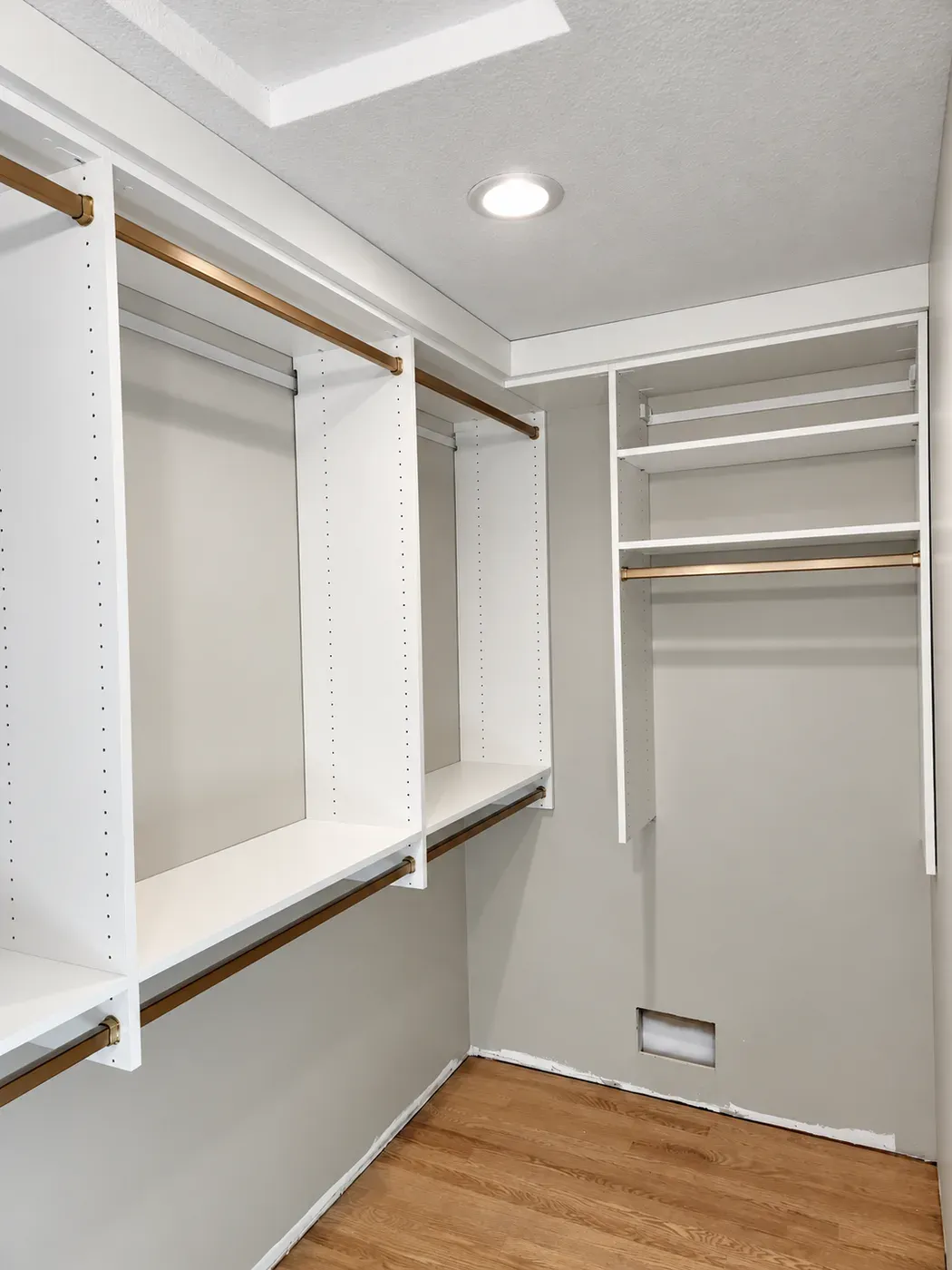
Double-hang rods along one wall and a shelf-and-rod unit on the end wall, Elko New Market, photographed before the baseboard went on.
Keep one section at full height for dresses, coats, and robes. The easiest way to size it is to measure your longest hanging item and add a few inches of clearance above the floor. Everything else can go on stacked rods. Rods need solid support too: a long run of clothes is heavier than it looks, and a rod supported only at its ends will bow. Longer runs need a center support fixed to the wall studs or the closet system's uprights.
Put a Shelf Tower on the End Wall
In a narrow walk-in, the end wall is usually too short to be worth a hanging rod, and it is the one wall you face as you walk in. A tower of shelves there holds folded sweaters, shoes, and bins at eye level, which keeps the aisle free and makes the closet look organized the moment you open the door.
Adjustable shelves are worth the small extra cost. Minnesota closets carry two wardrobes a year, and the shelf spacing that fits summer shirts will not fit winter sweaters. Being able to move a shelf up two inches in October is the difference between stacks that fit and stacks that topple.
Move Drawers into the Closet
Drawers inside the closet can replace a dresser in the bedroom, which is often the real space gain from a walk-in remodel. Socks, underwear, belts, and workout clothes are the items that clutter a small closet when they have no home, and a four- or five-drawer stack under a shelf tower gives them one.
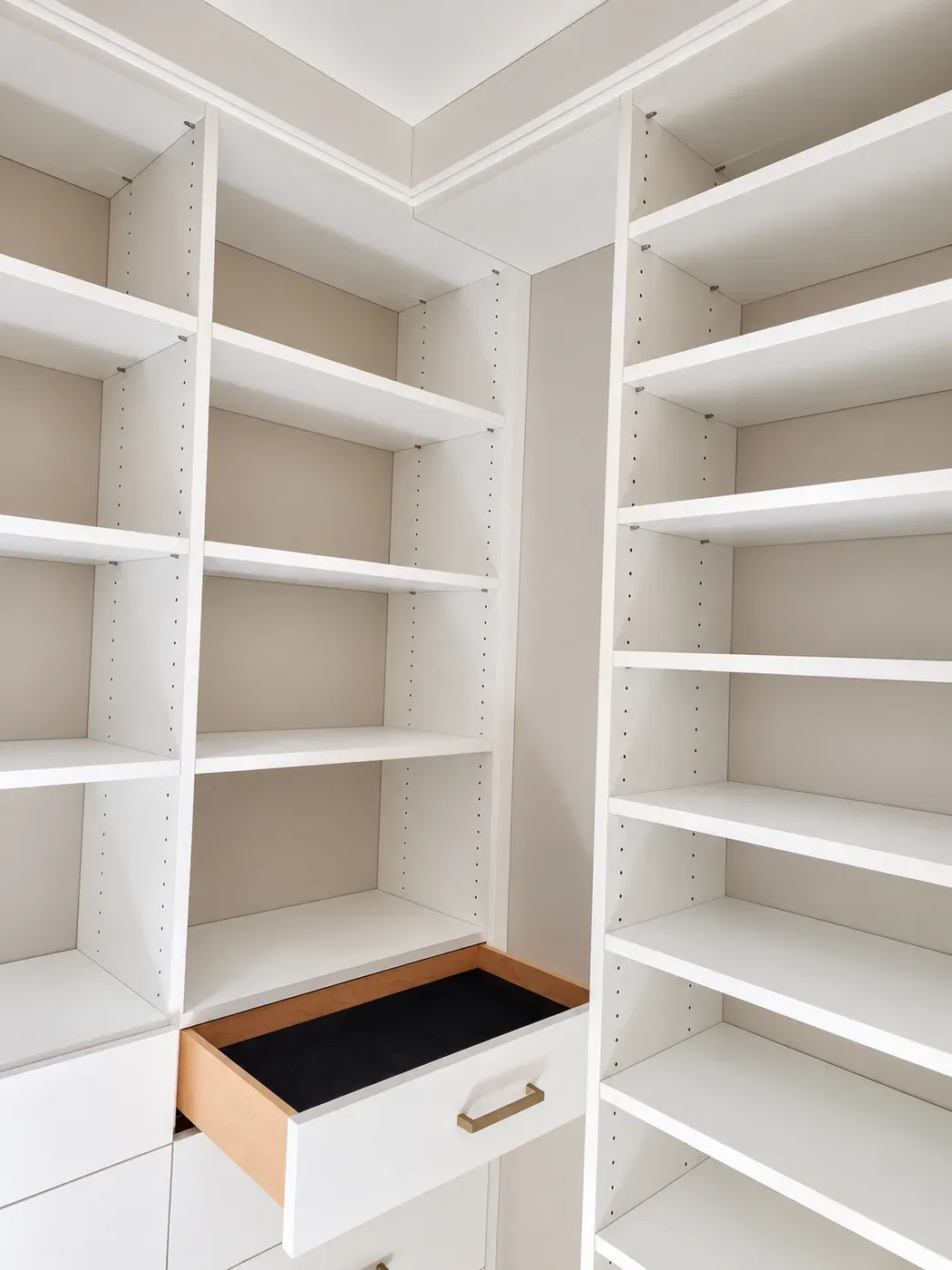
Shelf towers on two walls with a lined pull-out at the base, Elko New Market.
A deep pull-out at the bottom of a tower makes a good hamper, which keeps laundry off the closet floor. Wire baskets breathe better for gym clothes but can snag knits; a lined basket or a solid drawer avoids that. Whatever the style, check the pull-out clearance against your aisle before you order.
Use the End Wall for a Mirror
A full-length mirror at the end of a narrow closet does two jobs. It gives you a place to dress without leaving the closet, and it makes a tight space feel deeper because the reflection extends the aisle.
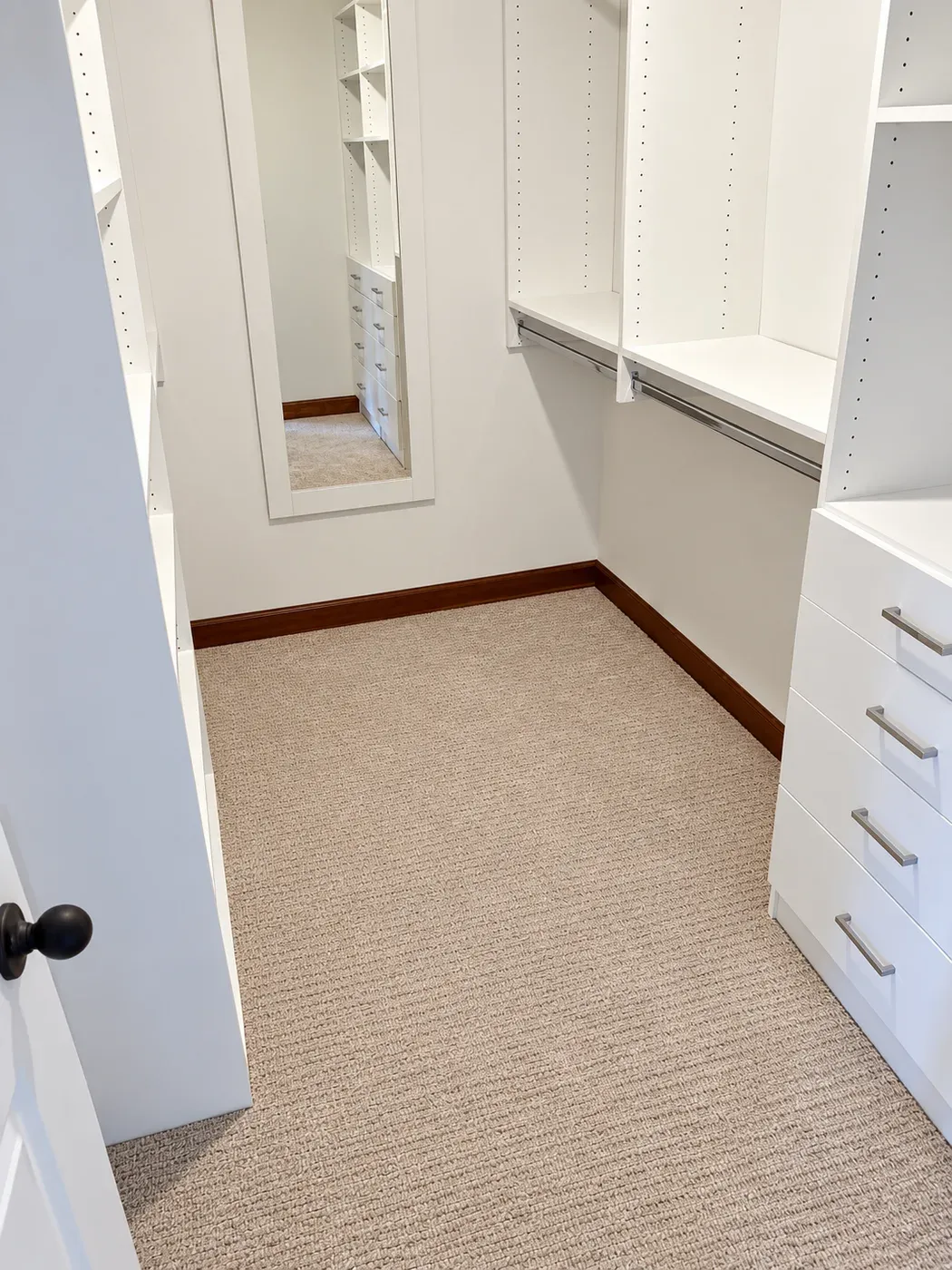
A full-length mirror on the end wall in Apple Valley, with hanging and drawers on the side walls.
If the end wall is already taken by shelves, the back of the door is the next best place for a mirror, as long as nothing on the door side stops it from opening fully.
Light It Without Breaking the Code
Good lighting is what makes a small closet usable, and it is also the part most often done wrong. The National Electrical Code, which Minnesota enforces through the Department of Labor and Industry, limits what kind of fixture can go in a clothes closet and how close it can sit to stored clothes:
- No bare bulbs. Fixtures with an exposed or partly exposed incandescent bulb are not allowed in a clothes closet, and neither are pendants.
- Surface-mounted LED with an enclosed lens needs at least 12 inches of clearance from the storage space, meaning the area over the shelves and hanging rods.
- Recessed LED with an enclosed lens needs at least 6 inches.
- LED strips or fixtures inside the shelving are allowed only if they are listed for installation within the closet storage space, which the manufacturer states in the installation instructions. The International Association of Electrical Inspectors explains how that marking works.
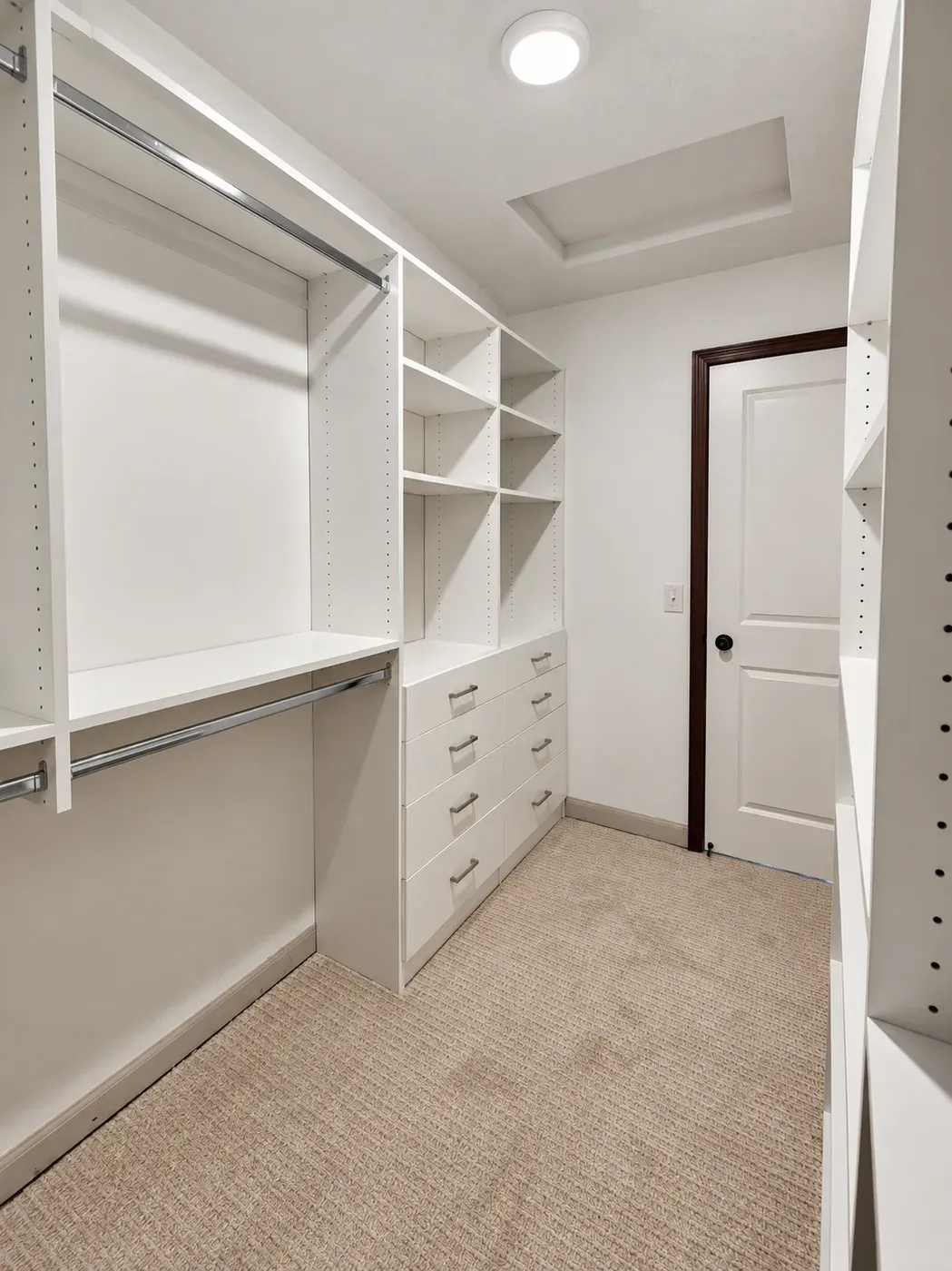
A flush ceiling light centered over the aisle, clear of the shelves and rods, Apple Valley.
In a small walk-in, the simplest compliant setup is one flush LED fixture centered on the ceiling over the aisle, which usually lands it far enough from the shelves on both sides. A switch outside the door or a motion or door-jamb switch keeps the light from being left on. If you want lit shelves, buy fixtures listed for closet storage space and plan an outlet or junction box for them before the shelving goes in.
Work the Corners and the Top Shelf
Corners are where small closets lose the most space. Where two walls of clothes rods meet, the inside corner becomes a pocket nobody can reach. Running shelves through the corner instead of hanging, or using a corner shelf unit, turns it into usable storage.
The top shelf, above the upper rod, is the other underused zone. It is the right place for what you use twice a year, and in Minnesota that means the seasonal swap: winter coats, boots, and snow gear in the spring, shorts and sandals in the fall. Bins labeled on the front make the swap a ten-minute job instead of an afternoon. A small folding step stool, stored in the closet, is what makes that shelf usable at all.
Measure Your Closet: Free Worksheet
Before you buy a closet system or ask for a quote, measure the room and count what you own. The two together decide the layout. The worksheet below is also a printable one-page PDF with room to sketch.
The room
- Back wall width, in inches
- Left wall depth, in inches
- Right wall depth, in inches
- Ceiling height, in inches
- Door width and which way it swings
- Distance from the door to the nearest corner
- Window, vent, attic hatch, switch, and outlet locations
What you hang
- Long items (dresses, coats, robes), count
- Your longest hanging item, in inches
- Short items (shirts, jackets, pants on hangers), count
What you fold and store
- Folded stacks (sweaters, jeans, t-shirts)
- Shoes, pairs
- Bags, hats, belts, and accessories
- Off-season bins
Before you choose a layout
- Every wall with a clothes rod has about 24 inches of depth in front of it
- The aisle is at least 24 inches clear, 36 if two people share it
- The door swing clears rods, shelves, and drawers, or can be rehung
- Drawers have room to pull out fully into the aisle
- Any light fixture is at least 12 inches from shelves and rods (6 if recessed)
- There is an outlet or junction box if you want lit shelves
Planning a Small Walk-In Closet Remodel
A small walk-in closet rarely needs more floor space. It needs the space it has laid out around what you actually own. Once the worksheet is filled in, the layout usually becomes obvious: which walls hang, where the drawers go, and whether the door has to change.
If you are starting from an empty room or a reach-in you want to open up, our guide to custom closet remodel planning covers budget trade-offs and the planning mistakes to avoid. Honey-Doers designs and builds custom closets across the south metro, and a filled-in worksheet is a good thing to have in hand when we meet. Contact us to get started.