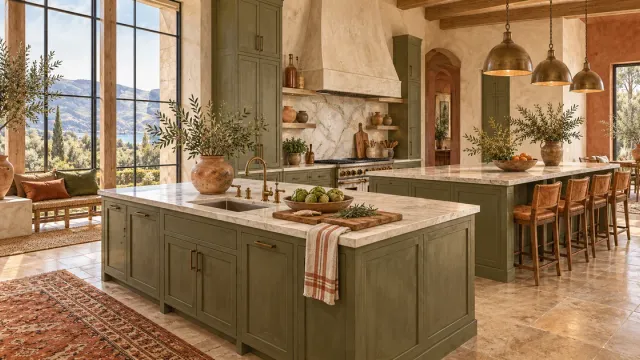
Picture Thanksgiving at your place. The turkey's resting, guests are filling glasses, and someone asks if they can help. You smile and say yes — but what you're really thinking is: please don't look at the sink.
In an open-concept home, there's no hiding the chaos. Roasting pans, prep bowls, and a cutting board still wearing stuffing residue are on full display from the dining room. For many Twin Cities homeowners, that tension between generous hosting and the reality of the kitchen is exactly why the scullery is making a comeback.
A scullery is a small, plumbed back kitchen beside the main one: a second sink, often a second dishwasher, bulk storage and counter space, behind a door, so dirty dishes and prep mess stay out of sight while you host. It works best when it sits within a few steps of the main kitchen and shares its plumbing wall.
From Victorian Utility to Modern Luxury
A scullery isn't a new idea. In the 19th century, it was the workhorse room tucked behind the main kitchen — where servants scrubbed pots and stored the overflow of a busy household. It fell out of favor when homes shrank and domestic help disappeared.
Today, it's back with a different name and a different purpose. You may hear it called a "dirty kitchen," a prep kitchen, or a back kitchen. Whatever the label, the concept is the same: a secondary workspace that absorbs the mess so your main kitchen stays photo-ready.
So what is a scullery, exactly, in a modern context? Think of it as a hidden backstage to your kitchen's main stage — fully plumbed, fully functional, and deliberately concealed behind a door or pocket wall. Guests see granite and pendant lights. You have somewhere to stack the sheet pans.
Scullery vs. Butler Pantry: What's the Difference?
These two terms get used interchangeably, but they're not quite the same thing.
A butler's pantry traditionally serves as a staging and storage space between the kitchen and dining room — a place to store fine china, decant wine, and plate courses before service. It's elegant and curated by design.
A scullery is more utilitarian at its core. Its job is cleanup, overflow prep, and concealment. It typically includes a sink (often a deeper one), supplemental appliances, and serious storage. Some modern designs blend both functions, but if your goal is managing hosting mess, the scullery function is the one doing the heavy lifting. If you already have a butler's pantry, converting it into a working mini kitchen is often the cheapest route to a scullery, since the room already exists. Houzz's roundup of butler's pantries shows how much overlap the two spaces can have in practice.
4 Features That Make a Modern Scullery Work
1. Secondary Cleanup Station
The anchor of any scullery is a deep, functional sink — often a single-basin farmhouse or utility sink that can swallow a stockpot without drama. Pair it with a second dishwasher and you've fundamentally changed how a dinner party ends.
Instead of loading one dishwasher in waves while guests linger, you can run both machines simultaneously and close the door on the mess entirely. The main kitchen stays clear for dessert and conversation.
Plan the sink and dishwasher as a pair. The NKBA Kitchen Planning Guidelines recommend keeping a dishwasher within 36 inches of the nearest edge of the sink it serves, with at least a 24-inch landing area on one side of that sink and 18 inches on the other. In a narrow scullery, those landing areas are usually what decides whether the room feels workable or cramped.
Why It Works:
- Extra dishwasher capacity means cleanup doesn't bottleneck at the end of the night
- Deep basin sink handles oversized cookware that won't fit in a standard sink
- Contained mess keeps soiled dishes, rinse water, and dish soap out of the main kitchen sightline
- Dedicated faucet frees up the main kitchen faucet for food prep during large meals
This is the feature to prioritize if you host often, have a large family, or cook multi-course meals where cleanup overlaps with the rest of the evening.
2. Integrated Appliance Garages
Countertop appliances are useful. They're also visual noise. A coffee station, a stand mixer, a toaster, a blender — individually they're fine, but together they make a kitchen feel cluttered even when it's clean.
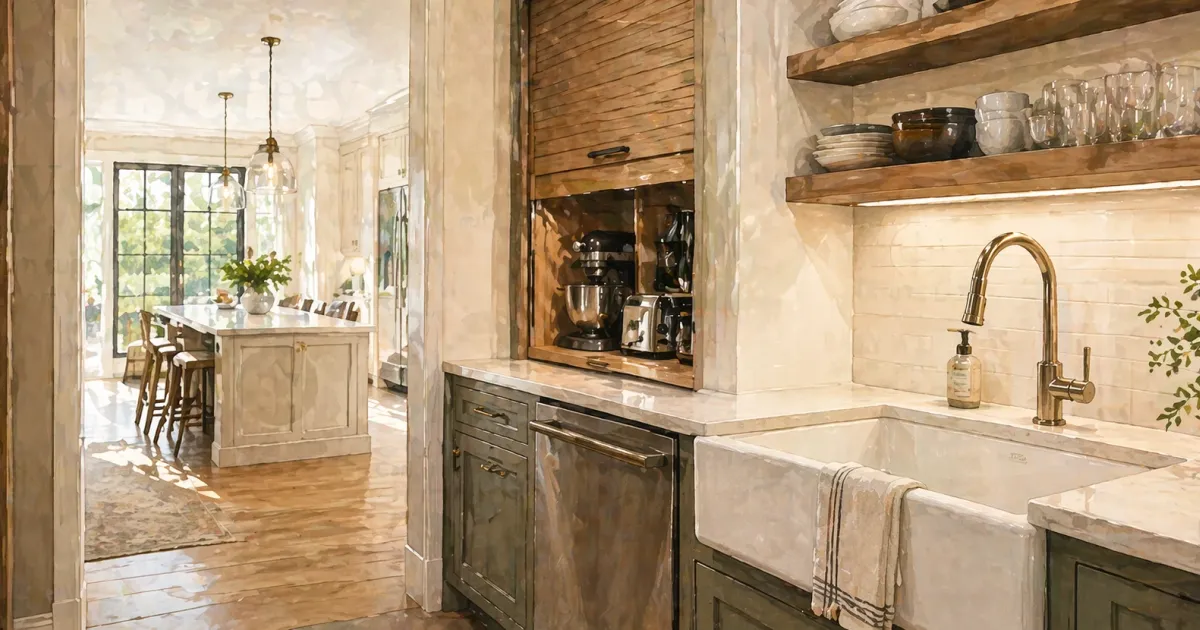
An appliance garage solves this with cabinetry designed to hide small appliances behind doors that fold, roll, or slide out of the way. In a scullery, you can take this further: dedicate an entire run of cabinetry to appliance storage, keeping everything plugged in and accessible without being visible.
Your main kitchen counters stay clear. Guests see a clean surface. You still have the coffee maker exactly where it belongs, plugged in and ready, with nothing to set up before use.
Size the garage around the appliances you actually own, from a toaster up to a countertop oven, and choose the door style (tambour, bi-fold or pocket) to match the rest of the cabinetry. Every appliance that lives there needs an outlet inside the cabinet, so settle the appliance list before the electrician roughs in. This is the feature that pays off most for anyone who owns a lot of small appliances and wants a clean main kitchen without giving up convenience.
3. Vertical Bulk Storage
Most kitchen storage is designed for everyday dishes. It's not built for the roasting pan that only comes out at Thanksgiving, the extra chafing dish for parties, or the stack of half-sheet pans you use when you're baking for a crowd.
A scullery gives you the vertical depth to store the oversized, the seasonal, and the occasionally used — without cramming it into the back of a cabinet or the top of the refrigerator. Tall pantry pulls, deep lower drawers, and open shelving scaled for large platters all have a home here.
This kind of storage also handles pantry overflow: bulk dry goods, extra paper towels, a case of sparkling water. Items that take up valuable kitchen real estate can live in the scullery and be pulled out when needed.
Why It Works:
- Vertical shelving accommodates large serving pieces and catering equipment
- Bulk pantry storage keeps the main kitchen stocked without crowding it
- Seasonal organization means holiday items have a home that isn't the basement
- Dedicated zones make pre-party prep faster when you know exactly where everything is
If you entertain seasonally, own catering-style serving pieces, or buy groceries in bulk, this is the storage you'll use most.
4. Dedicated Staging Counters
Plating is its own kind of work. Between the heat of the oven, the timing of multiple dishes, and the chaos of getting everything to the table at the right temperature, the last few minutes before a meal are the most stressful.
A staging counter in the scullery gives you a clean, dedicated surface to plate, garnish, and organize before service. No one's setting a glass down in your workspace. No one's reaching past you for a napkin. You have a clear runway.
This counter can also double as a bar setup before dinner — bottles, glassware, and ice staged out of the kitchen entirely so your prep space stays yours. One Annapolis family took this further, wrapping their scullery in stainless steel from cabinets to countertops for a surface that could take a beating during heavy staging and cleanup.
Because it's a dedicated zone rather than shared space, a staging counter is also easy to keep clear, which matters most in the busiest half hour before a meal. It earns its place for serious home cooks, for households where several people are often in the kitchen at once, and for anyone who's ever had to plate around a guest's wine glass.
How Much Space Does a Scullery Need?
Less than most people expect, but the aisle matters more than the square footage. The NKBA guidelines recommend a work aisle of at least 42 inches for one cook and 48 inches when two people work in the space at once, measured between counter fronts, tall cabinets or appliances. A plain walkway with no work zone on it should be at least 36 inches wide.
That points to three common layouts:
- Single-wall galley. One run of sink, dishwasher and counter with shelving or tall storage across from it. This fits where a 42-inch aisle plus counter depth fits, and it's the most common way to carve a scullery out of an existing walk-in pantry.
- Two-sided galley. Counters on both sides, with the sink on one wall and storage or an appliance garage on the other. Plan for the 48-inch aisle if two people will be cleaning up together.
- Pass-through scullery. A room with a door to the kitchen and a second door to a mudroom, garage entry or back hall, so groceries come in and trash goes out without crossing the main kitchen.
If the floor plan can't spare the room, the same goals can sometimes be met by reworking the main kitchen's layout into separate cleanup and prep zones instead.
Before You Build: A Scullery Planning Checklist
Adding a scullery to your home is a meaningful kitchen remodeling project. The design decisions are fun — the infrastructure decisions happen first. Work through this list before finalizing a layout:
- Plumbing access — Is there an existing drain line nearby, or will new plumbing need to be roughed in?
- Water supply lines — Does the planned location support both hot and cold supply for an additional sink?
- Dishwasher drain and power — A second dishwasher needs its own drain connection and a circuit sized to the manufacturer's instructions, and Minnesota's electrical code requires GFCI protection on dishwasher outlets
- Electrical capacity — Appliance garages and countertop appliances may require additional circuits; confirm with an electrician
- Ventilation — If the scullery includes a secondary cooktop, the NKBA recommends a ducted hood sized for it, at least 150 cfm
- Door placement — Where does the scullery open? Ideally it's accessible from both the kitchen and a back hallway
- Lighting — Task lighting over the sink and staging counter; under-cabinet lighting for the appliance zone
- Flooring continuity — Will the scullery share flooring with the kitchen, or is it a separate material?
- HVAC — Does the scullery need its own vent register, especially if it's a fully enclosed room?
- Permits — A new sink and new circuits mean plumbing and electrical permits; budget time for inspections before the walls close
Understanding our process from the start helps surface these questions early — before they become mid-project surprises.
Ready to Host Without the Stress?
A well-designed scullery doesn't just change how your kitchen looks. It changes how hosting feels — the difference between managing chaos and actually enjoying your own party.
If you're curious what a scullery addition could look like in your Twin Cities home, browse our project gallery for remodeling inspiration, then reach out to our team. We'll help you figure out what's possible — and what it takes to get there.