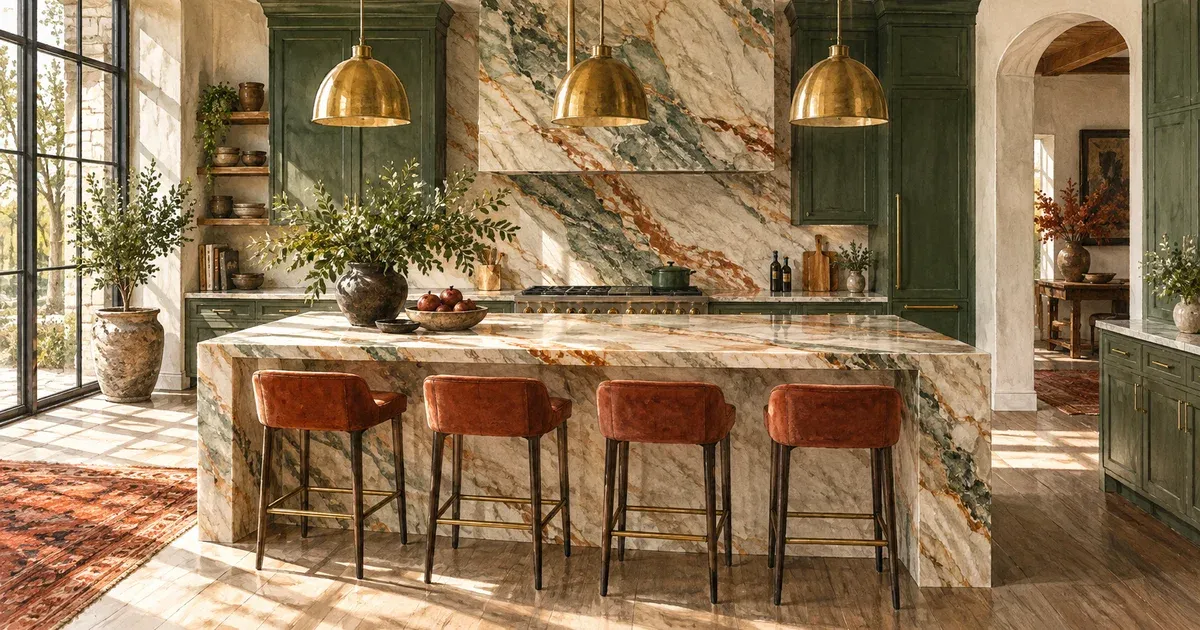
For about a decade, the default answer to kitchen countertops was white or grey and high-gloss. Polished Carrara. Bright quartz. Clean lines, cool tones, a surface that photographed well and asked nothing of you emotionally. That era is not gone, but it is no longer setting the direction.
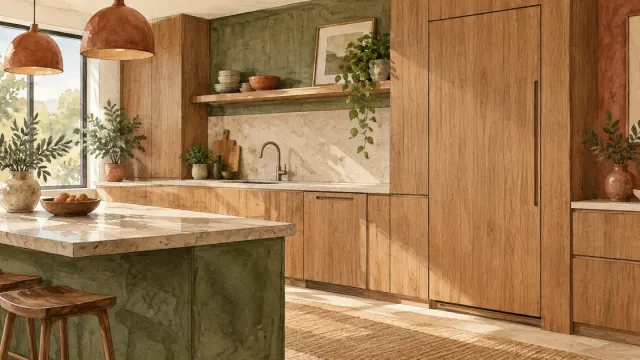
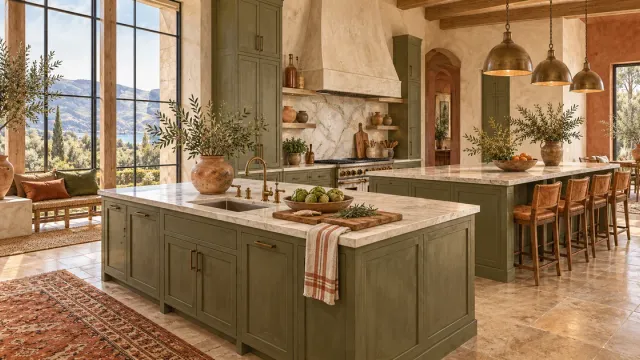
What is replacing it is harder to summarize in a single word. Warmer. More tactile. More specific. The surfaces earning attention in 2026 have grain, depth, and a quality that reads differently depending on the time of day or how the light hits them. They feel considered rather than default — which is exactly what the luxury kitchen market is asking for right now.
These eight trends reflect where the highest-end kitchen remodeling projects are landing, and what homeowners who care about both design and longevity are choosing.
- The Rise of Tactile Finishes — Trends 1, 2, and 3
- Bold Natural Stones — Trends 4, 5, and 6
- Seamless Architectural Integrations — Trends 7 and 8
- Common Mistakes to Avoid
- Countertop Lifestyle Match Checklist
The rise of tactile finishes — trends 1, 2, and 3
The biggest shift in countertop design is not about material. It is about surface treatment. The same stone that once would have been polished to a mirror finish is now being processed to feel and look completely different — and the results are changing how kitchens read from across the room.
Trend 1: Honed finish
A honed surface is ground to a smooth, flat finish without the final buffing that creates gloss. The result is a low-sheen, velvety surface that absorbs light rather than reflecting it. On marble, honed finishes have long been considered more traditional and architecturally serious than polished. On quartzite, the effect is striking — the natural grain and warmth of the stone read more clearly without glare in the way.
For homeowners weighing honed vs. polished quartz, the practical differences matter as much as the aesthetic ones. Polished surfaces show water spots and fingerprints readily. Honed surfaces are more forgiving in daily use, though they can be slightly more susceptible to staining on porous natural stones and may require sealing more attentively. On engineered quartz, honed finishes are essentially maintenance-neutral — the material is non-porous regardless of the surface treatment.
Trend 2: Leathered and brushed texture
Leathering is a more intensive process than honing. The surface is worked with diamond-tipped brushes that create subtle peaks and valleys, giving the stone a slightly rough, organic texture that reads almost like leather under the hand. It reduces glare significantly and is exceptional at hiding smudges, water marks, and everyday use.
Leathered finishes have historically been most common on darker granites and soapstone, where the texture adds dimension without muddying the color. That is changing. Lighter quartzites are now being leathered with sophisticated results — the texture adds movement to a surface that might otherwise read as flat.
Trend 3: Matte-finish engineered stone
Engineered quartz manufacturers have spent the last few years catching up to what natural stone has always offered in terms of finish variety. Matte quartz surfaces now closely approximate the look of honed natural stone while eliminating most of the maintenance complexity. For households with high traffic, young children, or a preference for lower-maintenance materials, matte-finish engineered stone is the practical path to the same aesthetic.
The quality gap between matte quartz and honed natural stone has narrowed considerably. At luxury price points, the differences are largely tactile rather than visual.
Bold natural stones — trends 4, 5, and 6
The material story in 2026 is largely a quartzite story, though it does not stop there. The broader trend is a move away from cool, anonymous surfaces toward stones that have character, warmth, and a sense of origin.
Trend 4: Warm-toned quartzite
Quartzite kitchen countertops are having a significant moment, and the timing makes sense. Quartzite has long offered something marble cannot — genuine hardness and acid resistance — while delivering the natural movement and warmth that engineered stone tends to flatten. The difference between quartzite and quartz is one of the most common points of confusion in kitchen planning: quartzite is a natural metamorphic rock formed from sandstone; quartz is an engineered composite of crushed stone and resin binders. They look similar in photos and perform very differently in practice.
The specific stones driving this trend are warm-toned varieties — and if you're budgeting for one, our kitchen remodeling cost guide covers where countertops typically land as a percentage of the total project. Taj Mahal quartzite — creamy white with subtle gold and taupe movement — has emerged as one of the most requested stones in luxury kitchen remodeling over the past two years. White Macaubas and Patagonia quartzite offer similar warmth with slightly more visible grain. All three perform durably under sealing, resist etching far better than marble, and photograph beautifully in kitchens with natural light.
Trend 5: Book-matched slab installations
Book-matching is the practice of opening two consecutive slabs like the pages of a book, creating a mirror-image pattern at the seam. When the veining is dramatic enough, the effect is architectural — a butterfly or cathedral pattern that reads as a designed feature rather than a material choice.
Book-matching is most impactful on islands and full-height backsplashes, where the slab area is large enough for the symmetry to register fully. It requires sourcing adjacent slabs from the same quarry lot, which adds a layer of planning and occasionally cost, but the result is one of the strongest visual differentiators available in a luxury kitchen. Done well, a book-matched island or backsplash is the detail that the room is remembered for.
Trend 6: High-contrast and rare marbles
Not everyone wants warmth. There is a concurrent trend — smaller in volume but strong at the very top of the market — toward marbles that are genuinely rare and visually commanding. Calacatta Viola, with its purple-grey veining on white, reads like no other stone in a kitchen. Verde Guatemala and Breccia Capraia introduce deep greens and rust tones that feel more like furniture than countertop. These are not default choices. They are statements, and they work precisely because they are unexpected.
For homeowners committed to a bold direction, the conversation about maintenance is essential before selection. Our guide to choosing kitchen counter materials covers the full material spectrum if you want a broader comparison before committing. These marbles are beautiful and they are porous. Acid exposure — citrus, vinegar, wine — will etch the polished surface over time. That does not make them impractical, but it does require a clear-eyed plan.
Seamless architectural integrations — trends 7 and 8
The highest-end kitchen remodels in 2026 are treating countertop material not just as a horizontal surface but as a continuous architectural element. These two trends reflect that shift.
Trend 7: Full-height stone backsplash
Running the countertop material from the surface to the underside of the upper cabinets — or all the way to the ceiling — eliminates grout lines, creates a seamless plane, and makes the material feel intentional rather than incidental. Full-height slab backsplashes are now among the most requested upgrades in luxury kitchen remodeling, and the reason is straightforward: they transform the perception of the kitchen more than almost any other single element.
Installation is more complex than tile. Slab backsplashes require precise templating, careful handling, and skilled cutting around outlets and switches. The cost is higher, but the visual return is substantial. When the countertop, backsplash, and island all share the same material, the kitchen achieves a coherence that nothing else quite replicates.
Trend 8: Sculptural edge profiles and waterfall islands
The edge of a countertop used to be a minor decision. In 2026, it is a design choice. Waterfall edges — where the slab continues vertically down the side of the island to the floor — create a clean, architectural silhouette that works especially well in open-concept spaces where the island is visible from multiple angles. Thick mitered edges, where multiple thin slabs are joined to simulate a much thicker profile, add visual weight and a furniture-like quality.
Live or organic edges, where the natural edge of the stone is preserved rather than cut straight, are appearing in kitchens where the goal is warmth and distinctiveness over precision. They require the right stone — a slab with an interesting natural edge — and they work best as a single statement piece rather than throughout.
Common mistakes to avoid
Choosing a porous material without a sealing plan. Natural stone — marble, quartzite, some granites — requires periodic sealing to prevent staining from oils, acids, and moisture. The frequency varies by material and use, but ranges from once annually to every few years. Minnesota's dry winter heating season pulls moisture out of the air and out of sealed stone faster than a humid climate would, and de-icing salt tracked in on boots adds another source of surface residue — both mean a porous countertop in a Twin Cities kitchen often needs resealing on the shorter end of that range. This is manageable and not a reason to avoid natural stone, but it is essential information. Homeowners who select a porous surface for a heavy-use family kitchen without understanding the maintenance commitment are the ones most likely to regret the decision.
Confusing quartzite with quartz. These are fundamentally different materials that require different care. Quartzite is natural, requires sealing, and resists acid better than marble. Quartz is engineered, requires no sealing, and resists acid and staining reliably. In a showroom, they can look nearly identical. Confirm what you are purchasing before fabrication begins — Houzz's guide to popular countertop materials is a useful reference for comparing performance side by side.
| Material | Hardness | Sealing | Acid Resistance | Relative Cost |
|---|---|---|---|---|
| Quartzite | Very high | Required, roughly annually | Excellent | High |
| Engineered quartz | High | Not required | Good | Moderate to high |
| Marble | Moderate | Required, roughly annually | Poor — etches easily | Moderate to high |
Not accounting for lighting direction when choosing a finish. Polished surfaces amplify light — in a dark kitchen, this can be an asset. In a south-facing kitchen with significant natural light, it can create uncomfortable glare. Honed and leathered surfaces absorb light. The right finish depends on the specific light conditions in your kitchen, not just what looks best in a sample.
Book-matching without securing adjacent slabs at purchase. Book-matching depends on having consecutively cut slabs from the same quarry block. If you fall in love with a stone and secure only one slab, the adjacent slab may be sold before fabrication begins. Purchase both — or all required — slabs at the same time and have them tagged and held.
Countertop lifestyle match checklist
Before selecting a material and finish, answer these questions honestly:
- How often do you cook? Daily cooking with acid-heavy ingredients — citrus, wine, vinegar, tomatoes — eliminates highly polished marble from consideration without an explicit maintenance commitment.
- Are children regularly using the kitchen? Prioritize scratch and stain resistance. Engineered quartz and quartzite outperform marble here.
- How much natural light does your kitchen receive? Glossy surfaces amplify light and glare. Honed or matte finishes absorb it. Know your light conditions before choosing a finish.
- Do you entertain regularly? If the kitchen is frequently on display, a high-impact material — book-matched slab, rare marble, full-height backsplash — earns the investment more often.
- Are you willing to seal annually? Marble and some quartzites require it. Engineered quartz does not. Be honest about this before committing.
- What is your fabrication and installation budget? Rare stones, book-matched slabs, full-height backsplashes, and sculptural edge profiles all carry higher fabrication labor costs beyond material cost alone. JLC's Cost vs. Value report tracks how upscale kitchen upgrades perform on return, and it's also worth knowing where to splurge and where to save across the broader project.
- How long do you plan to stay in the home? If you are remodeling for resale in under three years, durability and broad appeal matter more than personal statement. If you are staying, build for the life you actually live.
A countertop is one of the most-touched, most-seen surfaces in a home, and the best choice for one kitchen is rarely the best choice for another. The trends above reflect where design is heading, but the right material still comes down to how your household actually uses the space.
If you are working through a luxury kitchen remodel and want guidance on materials, finishes, and what holds up over time in this market, we'd be glad to help. Good countertop selection starts with understanding the room — and that is always a better starting point than a showroom sample in isolation.