Window sill replacement is worth it whenever a sill is soft, cracked, or actively letting in water — waiting past that point turns a contained repair into a window frame and wall-cavity problem. A window sill's job is simple: shed water away from the window and the wall below it. Once it stops doing that job, everything behind it is exposed, and modern, energy-efficient windows do not fix a failing sill underneath them.
For Twin Cities homeowners, that failure point arrives faster than it would in a drier climate. Snowmelt, ice, and repeated freeze-thaw cycling keep wood sills wet and expanding and contracting for months at a time, which is exactly the condition that turns a small crack into rot.
- Repair or Replace: How to Tell
- Warning Signs a Sill Needs Replacing
- What a Failing Sill Actually Costs You
- Why Minnesota Sills Fail Faster
- Frequently Asked Questions
Repair or replace: how to tell
A sill can be repaired, not replaced, when the damage is cosmetic and the wood underneath is still sound. Small surface cracks, chipped paint, or minor weathering can usually be filled and resealed, and that repair holds up fine as long as the wood itself has not started to soften.
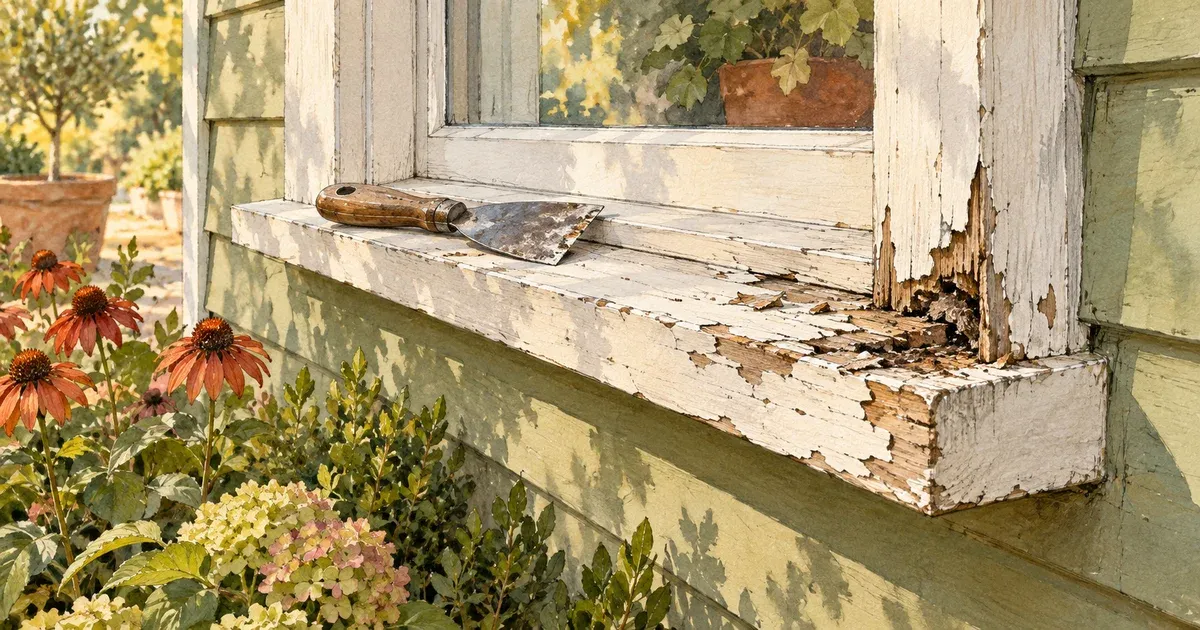
The test that actually matters is a simple one: press a screwdriver or an awl into the sill at a few points, especially near the corners and where the sill meets the window frame. Wood that gives easily, feels spongy, or crumbles is past the point of a surface repair, regardless of how the paint looks from a few feet away. Once wood has softened like that, sealant and filler have nothing solid left to bond to, and a repair will fail again within a season or two.
Warning signs a sill needs replacing
A sill in trouble rarely announces itself with one obvious symptom — it is usually a combination of smaller signs that add up.
Soft or spongy wood is the clearest signal, and it means moisture has already broken down the wood fibers, not just the paint surface. Visible cracks that run with the grain, rather than shallow surface checking, suggest the same thing starting to happen from the inside out. Paint that is peeling, bubbling, or discoloring specifically on the sill (while surrounding trim looks fine) often means water is getting trapped underneath rather than shedding off. A musty smell near the window, or visible mold on the sill or the wall just below it, means moisture has already been sitting there long enough to become a bigger problem than the sill alone. Windows that no longer close and latch cleanly can also point to a sill that has shifted or partially rotted, throwing the whole frame slightly out of alignment.
Any one of these on its own might still be a repair. Two or more together, especially soft wood plus a musty smell or visible mold, is a strong sign replacement is the right call.
Check sills from the inside as well as the outside. A sill can look intact from the yard while the interior side, hidden behind curtains or blinds, already shows water staining or soft wood — that's often where the damage is furthest along.
What a failing sill actually costs you
A sill's job is structural as much as cosmetic — it supports the bottom of the window frame and directs water away from the wall assembly below it. When it fails, the cost is rarely limited to the sill itself.
Water that gets past a failing sill travels into the wall cavity below the window, where it can sit against framing and sheathing for months before it becomes visible as an interior stain or a soft spot in drywall. By the time that damage shows up inside the house, the repair usually involves more than the sill — often wall framing, insulation, and interior finishes as well. According to ENERGY STAR, air leakage around window openings is also one of the more common sources of home energy loss, and a compromised sill is a direct path for both air and water infiltration, regardless of how efficient the window glass itself is.
Replacing a sill early, before it reaches that point, is one of the more cost-effective maintenance calls a homeowner can make relative to what a delayed repair ends up costing. A sill replaced while the damage is still contained keeps the repair to the sill, instead of the framing, insulation, and drywall behind it. It also protects the bigger investment next to it: window replacement is one of the projects the JLC Cost vs. Value report tracks for resale cost recovery, and a new window set into a rotting opening starts out compromised.
Why Minnesota sills fail faster
Minnesota's climate puts wood sills through more stress cycles per year than a milder region would. Snowmelt sits against the sill through late winter and early spring, and freeze-thaw cycling repeatedly expands and contracts both the wood and any sealant around it — the same mechanism that wears down roof flashing and deck fasteners faster here than elsewhere.
Older homes around Prior Lake and other established South Metro neighborhoods, many built before today's window flashing and sill-pan standards were common, tend to see this failure pattern earlier than newer construction. A sill installed without a proper sloped drainage plane or sill pan flashing has no built-in way to shed the water that does get past the window's outer seal, which is exactly the gap that Minnesota's wet, freeze-heavy winters find first.
If you're already planning a window replacement, a failing sill is worth addressing at the same time rather than as a separate project later — the sill and the window frame both need to be sound for either one to actually perform the way it's supposed to. A full siding and windows assessment can confirm whether the issue is isolated to the sill or part of a broader envelope problem.
Frequently asked questions
How do I know if my window sill needs to be replaced or just repaired?
Press a screwdriver or awl into the sill at a few points. If the wood is firm, a surface repair with filler and fresh sealant is usually enough. If it gives easily, feels spongy, or crumbles, the wood itself has broken down and needs replacement, not just a surface fix.
Can I repair a window sill myself?
Minor surface damage, like small cracks or chipped paint on otherwise solid wood, is a reasonable DIY repair with exterior-grade wood filler and sealant. Soft or rotted wood, visible mold, or any sign water has reached the wall cavity behind the sill is better handled by a professional, since the repair likely extends beyond the sill itself.
What happens if I ignore a rotted window sill?
Water continues past the sill into the wall cavity below the window, where it can damage framing, sheathing, and insulation before it ever becomes visible as an interior stain. What starts as a sill repair becomes a larger wall repair the longer it's left unaddressed.
Does a new window sill improve energy efficiency?
A sound, properly sealed sill closes off one of the more common paths for air and water infiltration around a window opening. It won't outperform the window glass itself, but a failing sill can undercut the efficiency of even a newer, well-rated window.
A window sill is easy to overlook because the window above it usually gets all the attention. But a sill that has started to fail undermines everything the window is supposed to do, and Minnesota's winters make that failure progress faster than homeowners often expect. If you're not sure whether what you're seeing is a quick repair or something more, contact us to have it assessed before the next freeze-thaw season adds to the damage.