Minnesota winters have a way of forcing decisions. When the sidewalks ice over and your aging parents are navigating three steps to their bathroom in the dark, the abstract conversation about “someday moving them closer” becomes urgent. For many Twin Cities families, the answer isn’t a memory care facility or a hastily furnished spare bedroom — it’s a thoughtfully designed in-law suite that gives everyone what they actually need: independence, privacy, and peace of mind.
A den, home office, or underused ground-floor room is often the right canvas. Converting it into a fully functional private suite doesn’t require adding square footage. It requires smart design.
What Makes a Suite Actually Work
The difference between a “nice guest room” and a true in-law suite comes down to a few fundamentals. The occupant needs to be able to function independently — morning routines, meals, and daily movement — without coordinating with the rest of the household. That means dedicated plumbing, thoughtful accessibility, and real acoustic separation.
It also means anticipating the future. A suite that works for a mobile 72-year-old parent should still work at 82. Building in accessibility features now, rather than retrofitting them later, is almost always cheaper and looks far better.
Six Conversion Ideas Worth Considering
1. Curbless Walk-In Shower with Integrated Grab Bars
A standard tub-shower combo is one of the most fall-prone environments in any home. For a parent with limited mobility or balance concerns, stepping over a tub edge is a real risk — especially on Minnesota winter mornings when joints are stiff.
A curbless shower eliminates the threshold entirely. Paired with grab bars positioned at entry, along the wall, and near the showerhead, it creates a space that’s both genuinely safe and visually elegant. Today’s grab bars come in brushed nickel, matte black, and chrome — they read as intentional design, not medical equipment.
Why It Works:
- Fall prevention — eliminates the single most common bathroom hazard for older adults
- Accessibility — accommodates walkers, shower chairs, and future wheelchair access
- Resale value — universal design appeals to a broad buyer pool
- Aesthetics — large-format tile and a frameless glass panel create a spa feel, not a clinical one
Ideal For: Families with a parent who has existing mobility limitations, or any household thinking 10+ years ahead about how this space will need to function.
2. Custom Kitchenette for Morning Independence
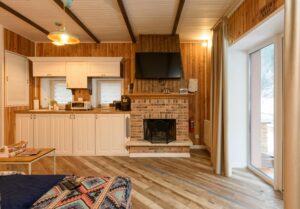
Sharing a kitchen is one of the fastest ways to erode everyone’s sense of autonomy. A compact kitchenette — a mini fridge, a two-burner induction cooktop, a small sink, and a few cabinets — gives the suite occupant a private domain for breakfast and light meals.
This doesn’t require a full kitchen remodel. A well-designed kitchenette can fit in 8–10 linear feet and tie into existing plumbing with a modest run. Cabinet height matters here: lower countertops and upper cabinets within comfortable reach serve both seated and standing users.
Why It Works:
- Autonomy — independent meal prep eliminates scheduling friction around the main kitchen
- Dignity — private space for personal routines without feeling like a guest
- Flexibility — can double as a hospitality bar or wet bar if the suite’s use changes
- Practical — reduces wear on the main kitchen for the primary household
Ideal For: Multi-generational households where schedules or dietary needs differ, and families who want the suite to function independently even if the parent’s needs change over time.
3. Widened Doorways with Pocket Doors
Standard interior doorways are 28–30 inches wide — enough for most people, but not enough for a walker or wheelchair. ADA guidelines recommend 32–36 inches of clear width. Widening to 36 inches during a conversion is a straightforward framing change that makes an enormous difference in how the space functions.
Pocket doors solve two problems at once: they eliminate the swing radius that standard doors require (critical in tight bathrooms), and they’re easier to operate for people with limited grip strength. Barn doors are a stylish alternative for closets and less-trafficked openings.
Why It Works:
- Accessibility — accommodates mobility aids now and in the future
- Space efficiency — no swing clearance required; every square foot stays usable
- Universal design — benefits all household members, not just aging occupants
- Code-forward — positions the home well for any future accessibility requirements
Ideal For: Conversions where the bathroom is tight, or any household that wants to build a suite that works across a wide range of physical abilities.
4. Sound-Insulated Shared Walls
Privacy is psychological as much as physical. A suite where every conversation, television program, and late-night trip to the bathroom is audible through the shared wall isn’t private — it’s just a bedroom with a door.
Sound insulation in shared walls involves a combination of approaches: dense-pack insulation in the wall cavity, resilient channel or double drywall to decouple the surfaces, and acoustic caulk around penetrations. It’s detail work, but the payoff is complete — both the suite occupant and the main household get genuine acoustic separation.
Why It Works:
- Real privacy — neither party monitors or overhears the other’s daily life
- Sleep quality — especially valuable when schedules differ (early risers, grandchildren)
- Comfort — reduces tension around noise without requiring behavioral changes
- Long-term — acoustic separation is nearly impossible to retrofit cheaply; do it during the conversion
Ideal For: Any shared-wall conversion, but especially critical when the suite wall is adjacent to a living room, kitchen, or children’s bedroom in the primary home.
5. Smart Lighting and Climate Controls
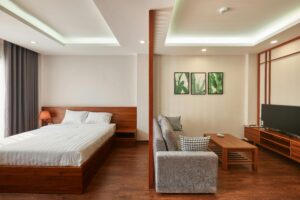
Aging eyes need more light — about three times as much as younger eyes to see the same detail. A suite designed with layered lighting (ambient, task, and nightlights at floor level) is dramatically safer and more comfortable than a room served by a single overhead fixture.
Programmable thermostats or a dedicated HVAC zone give the suite occupant independent temperature control. This is especially meaningful in Minnesota, where older adults often run warmer than younger family members. A separate zone also means no disputes over the main thermostat.
Why It Works:
- Safety — adequate lighting is a documented fall prevention factor
- Comfort — independent climate control without household compromise
- Energy efficiency — condition only the space that needs conditioning
- Independence — full control over the suite environment without asking anyone
Ideal For: Any in-law suite conversion, but especially valuable when the occupant has vision changes or sensory sensitivities to temperature.
6. Dedicated Exterior or Private Entry
Where layout allows, a private entry — even a simple door from the suite to a side patio — dramatically changes how the space feels. It gives the occupant the ability to come and go without moving through the primary household, receive visitors privately, and maintain the psychological experience of having their own home.
This isn’t always feasible depending on the den’s location, but when it is, it’s one of the highest-value additions to any in-law suite design. It also adds meaningful resale flexibility — a suite with a private entry has real potential as a rental unit if family needs change.
Why It Works:
- Independence — private comings and goings without coordination
- Dignity — feels like a home, not a room in someone else’s home
- Resale flexibility — opens rental or Airbnb possibilities if use changes
- Family dynamics — reduces the subtle pressure of shared main entry
Ideal For: Ground-floor dens with exterior wall access to a side yard, patio, or garage corridor. Particularly valuable in Minneapolis neighborhoods where lot sizes allow for a small private outdoor space.
Planning Checklist
Before converting your den, work through these key questions:
- Confirm the den is on the ground floor or has elevator/lift access
- Check Minneapolis zoning and permitting requirements for adding a kitchenette or secondary dwelling unit
- Verify whether a bathroom addition requires extending the home’s main drain stack
- Get a structural assessment if widening doorways will affect load-bearing walls
- Plan electrical capacity — kitchenettes, HVAC zones, and modern lighting all add load
- Decide on HVAC approach: extend existing system or add a mini-split for independent zone control
- Budget for acoustic work in shared walls before drywall goes up
- Confirm egress window requirements if the suite will be classified as a sleeping room
- Review your homeowner’s insurance implications for a secondary unit
- Walk through how we work so you understand what to expect from the planning and build process
Let’s Design Something Thoughtful
A well-built in-law suite is one of the most meaningful home investments a family can make. It’s not just square footage — it’s the difference between a parent who feels welcomed and one who feels warehoused.
At Honey-Doers, we’ve helped Twin Cities families create spaces that work for everyone under the roof. Browse our project gallery to see finished conversions, or get in touch to talk through what’s possible in your home. We’ll help you figure out what the space needs before anyone picks up a hammer.